


Page 59 - BBC Wildlife Volume 36 #02
P. 59
AGENDA OPINION


                                              Mark Carwardine’s

                                              AT A GLANCE...


                                        25
                                              CORAL BLEACHING


                           WHAT IS CORAL?             together cover an area no                                     more frequent, more
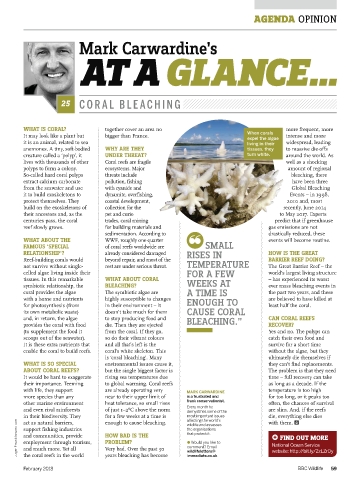
                                                                                                       When corals
                           It may look like a plant but   bigger than France.                                       intense and more
                                                                                                       expel the algae
                           it is an animal, related to sea                                             living in their   widespread, leading
                           anemones. A tiny, soft-bodied   WHY ARE THEY                                tissues, they   to massive die-offs
                           creature called a ‘polyp’, it   UNDER THREAT?                               turn white.   around the world. As
                           lives with thousands of other   Coral reefs are fragile                                  well as a shocking
                           polyps to form a colony.   ecosystems. Major                                             amount of regional
                           So-called hard coral polyps   threats include                                             bleaching, there
                           extract calcium carbonate   pollution, fishing                                             have been three
                           from the seawater and use   with cyanide and                                               Global Bleaching
                           it to build exoskeletons to   dynamite, overfishing,                                      Events – in 1998,
                           protect themselves. They   coastal development,                                          2010 and, most
                           build on the exoskeletons of   collection for the                                       recently, June 2014
                           their ancestors and, as the   pet and curio                                            to May 2017. Experts
                           centuries pass, the coral   trades, coral mining                                     predict that if greenhouse
                           reef slowly grows.         for building materials and                              gas emissions are not
                                                      sedimentation. According to                             drastically reduced, these
                           WHAT ABOUT THE             WWF, roughly one-quarter                                events will become routine.
                           FAMOUS ‘SPECIAL            of coral reefs worldwide are   ` SMALL
                           RELATIONSHIP’?             already considered damaged   RISES IN                   HOW IS THE GREAT
                           Reef-building corals would   beyond repair, and most of the                        BARRIER REEF DOING?
                           not survive without single-  rest are under serious threat.  TEMPERATURE           The Great Barrier Reef – the
                           celled algae living inside their                       FOR A FEW                   world’s largest living structure
                           tissues. In this remarkable   WHAT ABOUT CORAL                                     – has experienced its worst
                           symbiotic relationship, the   BLEACHING?               WEEKS AT                    ever mass bleaching events in
                           coral provides the algae   The symbiotic algae are     A TIME IS                   the past two years, and these
                           with a home and nutrients   highly susceptible to changes                          are believed to have killed at
                           for photosynthesis (from   in their environment – it   ENOUGH TO                   least half the coral.
                           its own metabolic waste)   doesn’t take much for them   CAUSE CORAL
                           and, in return, the algae   to stop producing food and   BLEACHING.”               CAN CORAL REEFS
                           provides the coral with food   die. Then they are ejected                          RECOVER?
                           (to supplement the food it   from the coral. If they go,                           Yes and no. The polyps can
                           scoops out of the seawater).   so do their vibrant colours                         catch their own food and
                           It is these extra nutrients that   and all that’s left is the                      survive for a short time
                           enable the coral to build reefs.  coral’s white skeleton. This                     without the algae, but they
                                                      is ‘coral bleaching’. Many                              ultimately die themselves if
                           WHAT IS SO SPECIAL         environmental issues cause it,                          they can’t find replacements.
                           ABOUT CORAL REEFS?         but the single biggest factor is                        The problem is that they need
                           It would be hard to exaggerate   rising sea temperatures due                       time – full recovery can take
                           their importance. Teeming   to global warming. Coral reefs                         as long as a decade. If the
                           with life, they support    are already operating very                              temperature is too high
                                                                                  MARK CARWARDINE
                           more species than any      near to their upper limit of   is a frustrated and      for too long, or it peaks too
                                                                                  frank conservationist.
                           other marine environment   heat tolerance, so small rises                          often, the chances of survival
                                                                                  Every month he
                           and even rival rainforests   of just 1–2ºC above the norm   demystifies some of the   are slim. And, if the reefs
                           in their biodiversity. They   for a few weeks at a time is   most important issues   die, everything else dies
                         Jurgen Freund/naturepl.com  support fishing industries   HOW BAD IS THE   the organisations    + FIND OUT MORE
                                                                                  affecting the world’s
                           act as natural barriers,
                                                      enough to cause bleaching.

                                                                                                              with them.
                                                                                  wildlife and assesses
                                                                                  that protect it.
                           and communities, provide
                                                      PROBLEM?
                           employment through tourism,
                                                                                  O Would you like to
                                                                                                               National Ocean Service
                                                                                  comment? Email
                                                      Very bad. Over the past 30
                           and much more. Yet all
                                                                                                               website: http://bit.ly/2zLZrDy
                                                                                  wildlifeletters@
                           the coral reefs in the world
                           February 2018              years bleaching has become   immediate.co.uk                      BBC Wildlife  59

