


Page 54 - BBC Wildlife Volume 36 #02
P. 54
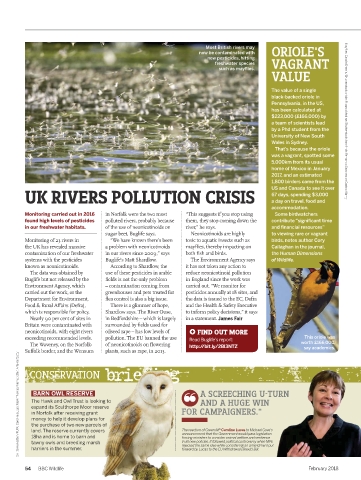
Most British rivers may
                                                                                      now be contaminated with   ORIOLE'S
                                                                                         new pesticides, hitting
                                                                                            freshwater species     VAGRANT
                                                                                             such as mayflies.
                                                                                                               VALUE

                                                                                                               The value of a single
                                                                                                               black-backed oriole in
                                                                                                               Pennsylvania, in the US,
                                                                                                               has been calculated at
                                                                                                               $223,000 (£166,000) by
                                                                                                               a team of scientists lead   Mayflies: Catalin Eremia/Shutterstock; oriole: Ricardo Medina/Shutterstock; hawfinch: Fernando Sanchez de Castro/Alamy
                                                                                                               by a Phd student from the
                                                                                                               University of New South
                                                                                                               Wales in Sydney.
                                                                                                                That’s because the oriole
                                                                                                               was a vagrant, spotted some
                                                                                                               5,000km from its usual
                                                                                                               home of Mexico in January
                                                                                                               2017, and an estimated
                                                                                                               1,800 birders came from the
                                                                                                               US and Canada to see it over
                           UK RIVERS POLLUTION CRISIS                                                          67 days, spending $3,000
                                                                                                               a day on travel, food and
                                                                                                               accommodation.
                           Monitoring carried out in 2016   in Norfolk were the two most  “This suggests if you stop using  Some birdwatchers
                           found high levels of pesticides   polluted rivers, probably because   them, they stop coming down the  contribute “significant time
                           in our freshwater habitats.   of the use of neonicotinoids on   river,” he says.    and financial resources”
                                                       sugar beet, Buglife says.   Neonicotinoids are highly   to viewing rare or vagrant
                           Monitoring of 23 rivers in   “We have known there’s been   toxic to aquatic insects such as   birds, notes author Cory
                           the UK has revealed massive   a problem with neonicotinoids  mayflies, thereby impacting on  Callaghan in the journal,
                           contamination of our freshwater   in our rivers since 2009,” says   both fish and birds.  the Human Dimensions
                           systems with the pesticides  Buglife’s Matt Shardlow.   The Environment Agency says  of Wildlife.
                           known as neonicotinoids.     According to Shardlow, the  it has not taken any action to
                             The data was obtained by   use of these pesticides in arable   reduce neonicotinoid pollution
                           Buglife but not released by the   fields is not the only problem  in England since the work was
                           Environment Agency, which   – contamination coming from   carried out. “We monitor for
                           carried out the work, or the   greenhouses and pets treated for   pesticides annually at 18 sites, and
                           Department for Environment,  flea control is also a big issue.  the data is issued to the EC, Defra
                           Food & Rural Affairs (Defra),  There is a glimmer of hope,   and the Health & Safety Executive
                           which is responsible for policy.  Shardlow says. The River Ouse,   to inform policy decisions,” it says
                             Nearly 90 per cent of sites in  in Bedfordshire – which is largely  in a statement. James Fair
                           Britain were contaminated with  surrounded by fields used for
                           neonicotinoids, with eight rivers  oilseed rape – has low levels of   + FIND OUT MORE
                           exceeding recommended levels.  pollution. The EU banned the use  Read Buglife’s report:        This oriole was
                             The Waveney, on the Norfolk-  of neonicotinoids on flowering   http://bit.ly/2Bl3NTZ         worth £166,000,
                                                                                                                          say academics.
                           Suffolk border, and the Wensum   plants, such as rape, in 2013.
                         Owl: Simon Litten/FLPA; Caroline Lucas: Mark Thomas/Alamy; otter: Arterra/Getty

                                                ON
                             CONSERVATION             briefing

                                                 E
                              BARN OWL RESERVE                                         A SCREECHING U-TURN
                             The Hawk and Owl Trust is looking to                `     AND A HUGE WIN
                                                o
                             expand its Sculthorpe Moor reserve
                                                                                FOR
                             in Norfolk after receiving grrant                  FOR CAMPAIGNERS."
                             money to help it develop plans for
                             the purchase of two new paarcels of
                             land. The reserve currently covers                 The rea c ction of Green MP Caroline Lucas to Michael Gove’s
                                                                                announc cement that the Government would pass legislation
                             18ha and is home to barn and                       forcing m
                                                                                    ministers to consider animal welfare and sentience
                                                                                    w policies. It followed political controversy when MPs
                                                m
                             tawny owls and breeding marsh                      in all new
                                                                                rejected  the same idea while considering an amendment put
                             harriers in the summer.                            forward b by Lucas to the EU Withdrawal (Brexit) Bill.
                           54   BBC Wildlife                                                                               February 2018

