


Page 73 - BBC Wildlife Volume 36 #02
P. 73
KOB ANTELOPE


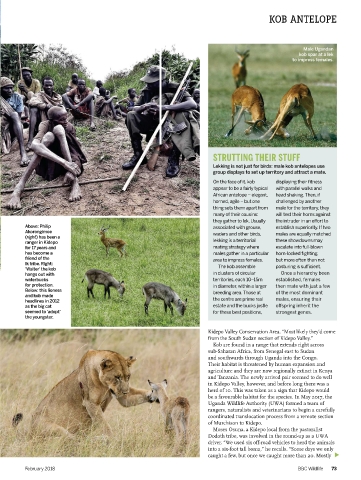
                                                                                                                          Male Ugandan
                                                                                                                        kob spar at a lek
                                                                                                                      to impress females.


                                                                                           STRUTTING THEIR STUFF
                                                                                           Lekking is not just for birds: male kob antelopes use
                                                                                           group displays to set up territory and attract a mate.
                                                                                           On the face of it, kob   displaying their fitness
                                                                                           appear to be a fairly typical   with parallel walks and
                                                                                           African antelope – elegant,   head shaking. Then, if
                                                                                           horned, agile – but one   challenged by another
                                                                                           thing sets them apart from   male for the territory, they
                                                                                           many of their cousins:   will test their horns against
                                                                                           they gather to lek. Usually   the intruder in an effort to
                           Above: Philip                                                   associated with grouse,   establish superiority. If two
                           Akorongimoe
                                                                                           waders and other birds,   males are equally matched
                           (right) has been a
                                                                                           lekking is a territorial   these showdowns may
                           ranger in Kidepo
                           for 17 years and                                                mating strategy where   escalate into full-blown
                           has become a                                                    males gather in a particular   horn-locked fighting,
                           friend of the
                                                                                           area to impress females.  but more often than not
                           Ik tribe. Right:
                                                                                             The kob assemble   posturing is sufficient.
                           ‘Walter’ the kob
                           hangs out with                                                  in clusters of circular   Once a hierarchy been
                           waterbucks                                                      territories, each 10–15m   established, females
                           for protection.                                                 in diameter, within a larger   then mate with just a few
                           Below: this lioness
                                                                                           breeding area. Those at   of the most dominant
                           and kob made
                                                                                           the centre are prime real   males, ensuring their
                           headlines in 2012
                           as the big cat                                                  estate and the bucks jostle   offspring inherit the
                           seemed to ‘adopt’                                               for these best positions,   strongest genes.
                           the youngster.
                                                                                         Kidepo Valley Conservation Area. “Most likely they’d come
                                                                                         from the South Sudan section of Kidepo Valley.”
                                                                                           Kob are found in a range that extends right across
                                                                                         sub-Saharan Africa, from Senegal east to Sudan
                                                                                         and southwards through Uganda into the Congo.
                                                                                         Their habitat is threatened by human expansion and
                                                                                         agriculture and they are now regionally extinct in Kenya
                                                                                         and Tanzania. The newly arrived pair seemed to do well
                                                                                         in Kidepo Valley, however, and before long there was a
                                                                                         herd of 10. This was taken as a sign that Kidepo would
                                                                                         be a favourable habitat for the species. In May 2017, the
                                                                                         Uganda Wildlife Authority (UWA) formed a team of
                                                                                         rangers, naturalists and veterinarians to begin a carefully
                                                                                         coordinated translocation process from a remote section
                                                                                         of Murchison to Kidepo.
                                                                                           Moses Osuna, a Kidepo local from the pastoralist
                                                                                         Dodoth tribe, was involved in the round-up as a UWA
                                                                                         driver. “We used six off-road vehicles to herd the animals
                                                                                         into a six-foot tall boma,” he recalls. “Some days we only
                                                                                         caught a few, but once we caught more than 20. Mostly
                           February 2018                                                                                BBC Wildlife  73

