


Page 74 - BBC Wildlife Volume 36 #02
P. 74
problems – sharing a frontier with South Sudan and
northern Kenya’s Turkana district,” says chief warden
Masereka. “But we have the support of the Ugandan
People’s Defence Force to control armed dissidents in the
area and we have rangers at 11 outposts. We have more
than adequate manpower, and since disarmament in the
Karamojong area in around 2008–2009 we have had no
security issues and little poaching in the park.”
THE EARLY SIGNS ARE PROMISING, AND Kidepo’s Narus Valley gets its name from a local
Karamojong word meaning ‘muddy’ and it is the floodplains
here that help to guarantee a sustainable habitat for
DISCUSSIONS ARE ALREADY UNDERWAY
grazers even when the bigger Kidepo Valley has dried out
FOR THE TRANSLOCATION OF MORE KOB.
completely. Kob are highly dependent on water – though one
subspecies, the white-eared kob, undertakes long-distance
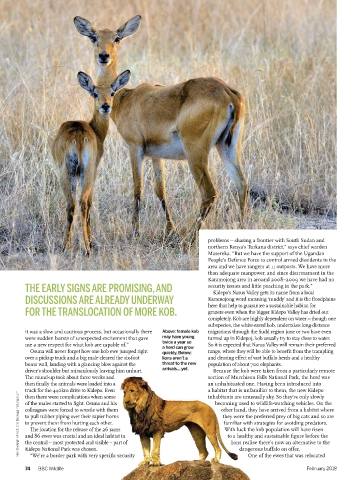
it was a slow and cautious process, but occasionally there Above: female kob migrations through the Sudd region (one or two have even
were sudden bursts of unexpected excitement that gave may have young turned up in Kidepo), kob usually try to stay close to water.
twice a year so
me a new respect for what kob are capable of.” So it is expected that Narus Valley will remain their preferred
a herd can grow
Osuna will never forget how one kob ewe jumped right quickly. Below: range, where they will be able to benefit from the trampling
over a pickup truck and a big male cleared the six-foot lions aren’t a and clearing effect of vast buffalo herds and a healthy
boma wall, landing with a glancing blow against the threat to the new population of about 700 elephants.
als
arriv
e
t
…
y
driver’s shoulder but miraculously leaving him unhurt. arrivals… yet. . Because the kob were taken f
ulously leaving him unhurt.
Because the kob were taken from a particularly remote
hree weeks and
The round-up took about three weeks and section of Murchison Falls National Park, the herd was
section of Murchison Falls Nati
re loaded into a
an unhabituated one. Having been introduced into
then finally the animals were loaded into a an unhabituated one. Having b
truck for the 440km drive to Kidepo. Even a habitat that is unfamiliar to them, the new Kidepo
o Kidepo. Even
a habitat that is unfamiliar to th
Mark Eveleigh x4; kob: Eric Baccega/naturepl.com colleagues were forced to wrestle with them other hand, they have arr
inhabitants are unusually shy. So they’re only slowly
inhabitants are unusually shy. S
then there were complications when some
ons when some
. Osuna and his
of the males started to fight. Osuna and his
becoming used to wildlife-watching vehicles. On the
becoming used to wildlife-w
other hand, they have arrived from a habitat where
restle with them
they were the preferred p
heir rapier horns
they were the preferred prey of big cats and so are
to pull rubber piping over their rapier horns
familiar with strategies for avoiding predators.
ng each other.
to prevent them from hurting each other.
familiar with strategies
With luck the kob popu
The location for the release of the 26 rams
With luck the kob population will have risen
se of the 26 rams
to a healthy and sustai
d an ideal habitat in
and 86 ewes was crucial and an ideal habitat in
to a healthy and sustainable figure before the
d and visible – part of
the central – most protected and visible – part of
lions realise there’s now an alternative to the
lions realise there’s n
dangerous buffal
Kidepo National Park was chosen.
hosen.
One of the ewes that was relocated
th very specific security
One of the ew
74 “We’re a border park with very specific security dangerous buffalo on offer. February 2018
BBC Wildlife

