


Page 8 - BBC Wildlife Volume 36 #02
P. 8
Y
RUA
R
WILD FEBRUARY
Q RED FOX
O
L
O
O
O
O
F
O
O
O
A
L
L
L
L
AL
CALL OF THE WILDWILD
L
L
L
CA L L O F T H E W
L
L
H
H
H
H
T
H
H
E
E
W
E
H
E
E
F
F
T
T
F
F
F
F
T
T
T
T
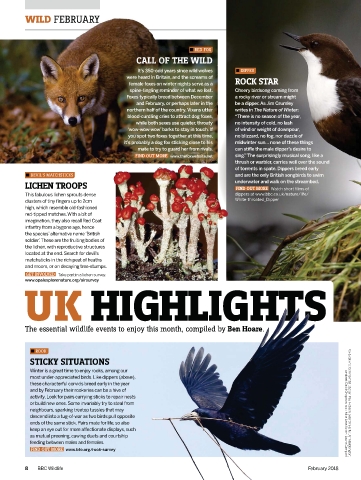
It’s 350-odd years since wild wolves Q DIPPER
were heard in Britain, and the screams of
female foxes on winter nights serve as a ROCK STAR
spine-tingling reminder of what we lost. Cheery birdsong coming from
Foxes typically breed between December a rocky river or stream might
and February, or perhaps later in the be a dipper. As Jim Crumley
northern half of the country. Vixens utter writes in The Nature of Winter:
blood-curdling cries to attract dog foxes, “There is no season of the year,
while both sexes use quieter, throaty no intensity of cold, no lash
‘wow-wow-wow’ barks to stay in touch. If of wind or weight of downpour,
you spot two foxes together at this time, no blizzard, no fog, nor dazzle of
it’s probably a dog fox sticking close to his midwinter sun… none of these things
mate to try to guard her from rivals. can stifle the male dipper’s desire to
FIND OUT MORE www.thefoxwebsite.net sing.” The surprisingly musical song, like a
thrush or warbler, carries well over the sound
of torrents in spate. Dippers breed early
Q DEVIL’S MATCHSTICKS and are the only British songbirds to swim
underwater and walk on the streambed.
LICHEN TROOPS FIND OUT MORE Watch short films of
This fabulous lichen sprouts dense dippers at www.bbc.co.uk/nature/life/
clusters of tiny fingers up to 2cm White-throated_Dipper
high, which resemble old-fashioned
red-tipped matches. With a bit of
imagination, they also recall Red Coat
infantry from a bygone age, hence
the species’ alternative name ‘British
soldier’. These are the fruiting bodies of
the lichen, with reproductive structures
located at the end. Search for devil’s
matchsticks in the rich peat of heaths
and moors, or on decaying tree-stumps.
GET INVOLVED Take part in a lichen survey:
www opalexplorenature org/airsurvey
www . op ale xplor enatur e . or g/ air sur v e y
UKK
The essential wildlife events to enjoy this month, compiled by Ben Hoare.
Q ROOK
STICKY SITUATIONS
Winter is a great time to enjoy rooks, among our
most under-appreciated birds. Like dippers (above),
these characterful corvids breed early in the year
and by February their rookeries can be a hive of
activity. Look for pairs carrying sticks to repair nests
or build new ones. Some invariably try to steal from Fox & catkins: Colin Varndell; dipper: Paul Hobson; celandine & fly: John Bebbington;
neighbours, sparking treetop tussles that may
descend into a tug-of-war as two birds pull opposite parakeet: David Chapman; rook: Mike Lane; lichen: Laurie Campbell
ends of the same stick. Pairs mate for life, so also
keep an eye out for more affectionate displays, such
as mutual preening, cawing duets and courtship
feeding between males and females.
FIND OUT MORE www.bto.org/rook-survey
8 BBC Wildlife February 2018

