


Page 301 - (DK Eyewitness) Travel Guide - Morocco
P. 301
SOUTHERN MOROC C O & WESTERN SAHAR A 299
The Nomad’s Tent
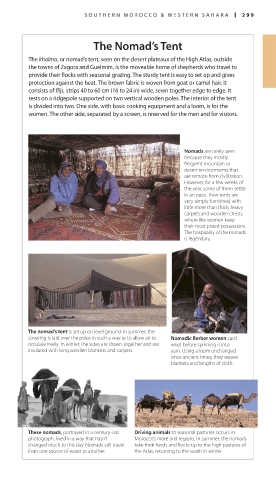
The khaïma, or nomad’s tent, seen on the desert plateaux of the High Atlas, outside
the towns of Zagora and Guelmim, is the moveable home of shepherds who travel to
provide their flocks with seasonal grazing. The sturdy tent is easy to set up and gives
protection against the heat. The brown fabric is woven from goat or camel hair. It
consists of flijs, strips 40 to 60 cm (16 to 24 in) wide, sewn together edge to edge. It
rests on a ridgepole supported on two vertical wooden poles. The interior of the tent
is divided into two. One side, with basic cooking equipment and a loom, is for the
women. The other side, separated by a screen, is reserved for the men and for visitors.
Nomads are rarely seen
because they mostly
frequent mountain or
desert environments that
are remote from civilization.
However, for a few weeks of
the year, some of them settle
in an oasis. Their tents are
very simply furnished, with
little more than thick, heavy
carpets and wooden chests
where the women keep
their most prized possessions.
The hospitality of the nomads
is legendary.
The nomad’s tent is set up on level ground. In summer, the
covering is laid over the poles in such a way as to allow air to Nomadic Berber women card
circulate freely. In winter, the sides are drawn together and are wool before spinning it into
insulated with long woollen blankets and carpets. yarn. Using a loom unchanged
since ancient times, they weave
blankets and lengths of cloth.
These nomads, portrayed in a century-old Driving animals to seasonal pastures occurs in
photograph, lived in a way that hasn’t Morocco’s more arid regions. In summer, the nomads
changed much to this day. Nomads still travel take their herds and flocks up to the high pastures of
from one source of water to another. the Atlas, returning to the south in winter.
298-299_EW_Morocco.indd 299 09/08/16 11:20 am

