


Page 299 - (DK Eyewitness) Travel Guide - Morocco
P. 299
SOUTHERN MOROC C O & WESTERN SAHAR A 297
colonial style of some of the Monk Seals
buildings – such as the former
Spanish Consulate and the The largest colony of monk seals (Monachus monachus) in
Hispano-Berber Art Deco church the Mediterranean area is found along the Atlantic coast, in the
that is now the law courts – gives very south of Morocco. In 1995, 200 seals still existed here but
the town an unusual aspect. half the colony was destroyed by disease in 1998, and it faces a
very uncertain future. This brown seal can grow to a length of
3 m (10 ft) and weigh up to
8 Tafraoute 300 kg (660 lb). During the 20th
century it has disappeared from
143 km (89 miles) southeast of Agadir. the Canary Islands archipelago,
Road N1 from Agadir then road R105; Madeira and most of the islands
road R104 from Tiznit. * 1,700. of the Mediterranean. Today, it is
@ Tiznit and Agadir, or grands taxis. still to be found in the Black Sea
n ONMT Agadir. ( Souk Tue & Wed. and on the Bulgarian and Turkish
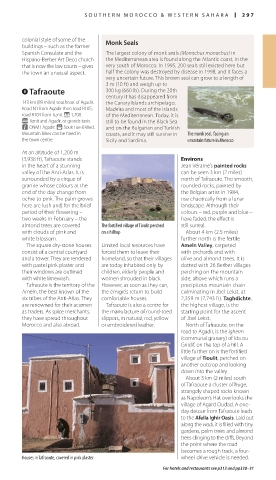
Mountain bikes can be hired in coasts, and it may still survive in The monk seal, facing an
the town centre. Sicily and Sardinia. uncertain future in Morocco
At an altitude of 1,200 m
(3,938 ft), Tafraoute stands Environs
in the heart of a stunning Jean Vérame’s painted rocks
valley of the Anti-Atlas. It is can be seen 3 km (2 miles)
surrounded by a cirque of north of Tafraoute. The smooth,
granite whose colours at the rounded rocks, painted by
end of the day change from the Belgian artist in 1984,
ochre to pink. The palm groves rise chaotically from a lunar
here are lush and, for the brief landscape. Although their
period of their flowering – colours – red, purple and blue –
two weeks in February – the have faded, the effect is
almond trees are covered The fortified village of Tioulit perched still surreal.
with clouds of pink and on a hilltop About 4 km (2.5 miles)
white blossom. further north is the fertile
The square dry-stone houses Limited local resources have Ameln Valley, carpeted
consist of a central courtyard forced them to leave their with orchards and with
and a tower. They are rendered homeland, so that their villages olive and almond trees. It is
with pastel pink plaster and are today inhabited only by dotted with 26 Berber villages
their windows are outlined children, elderly people and perching on the mountain
with white limewash. women shrouded in black. side, above which runs a
Tafraoute is the territory of the However, as soon as they can, precipitous mountain chain
Ameln, the best known of the the émigrés return to build culminating in Jbel Lekst, at
six tribes of the Anti-Atlas. They comfortable houses. 2,359 m (7,743 ft). Taghdichte,
are renowned for their acumen Tafraoute is also a centre for the highest village, is the
as traders. As spice merchants, the manufacture of round-toed starting point for the ascent
they have spread throughout slippers, in natural, red, yellow of Jbel Lekst.
Morocco and also abroad. or embroidered leather. North of Tafraoute, on the
road to Agadir, is the igherm
(communal granary) of Ida ou
Gnidif, on the top of a hill. A
little further on is the fortified
village of Tioulit, perched on
another outcrop and looking
down into the valley.
About 3 km (2 miles) south
of Tafraoute a cluster of huge,
strangely shaped rocks known
as Napoleon’s Hat overlooks the
village of Agard Oudad. A one-
day detour from Tafraoute leads
to the Afella Ighir Oasis. Laid out
along the wadi, it is filled with tiny
gardens, palm trees and almond
trees clinging to the cliffs. Beyond
the point where the road
becomes a rough track, a four-
Houses in Tafraoute, covered in pink plaster wheel-drive vehicle is needed.
For hotels and restaurants see p313 and pp330–31
296-297_EW_Morocco.indd 297 09/08/16 11:20 am

