


Page 84 - 100% Biker (January 2020)
P. 84
BUILD FEATURE PROJECT FLATTRACK


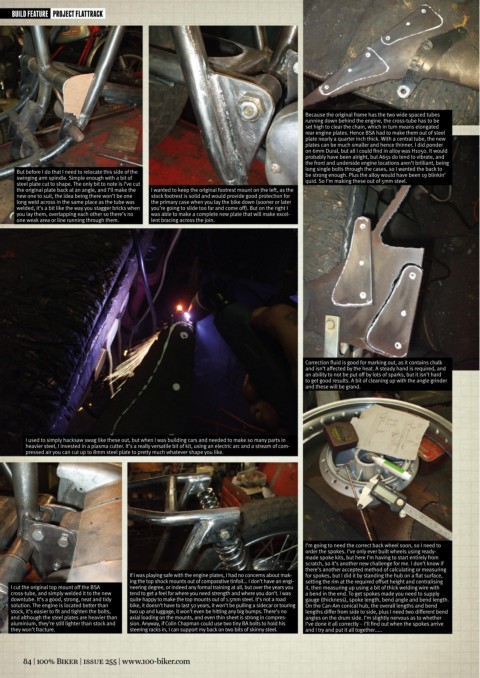
                                                                                                        Because the original frame has the two wide spaced tubes
                                                                                                        running down behind the engine, the cross-tube has to be
                                                                                                        set high to clear the chain, which in turn means elongated
                                                                                                        rear engine plates. Hence BSA had to make them out of steel
                                                                                                        plate nearly a quarter inch thick. With a central tube, the new
                                                                                                        plates can be much smaller and hence thinner. I did ponder
                                                                                                        on 6mm Dural, but all I could find in alloy was H1050. It would
                                                                                                        probably have been alright, but A65s do tend to vibrate, and
                                                                                                        the front and underside engine locations aren’t brilliant, being
                                                                                                        long single bolts through the cases, so I wanted the back to
      But before I do that I need to relocate this side of the                                          be strong enough. Plus the alloy would have been 19 blinkin’
      swinging arm spindle. Simple enough with a bit of                                                 quid. So I’m making these out of 5mm steel.
      steel plate cut to shape. The only bit to note is I’ve cut
      the original plate back at an angle, and I’ll make the   I wanted to keep the original footrest mount on the left, as the
      new one to suit, the idea being there won’t be one   stock footrest is solid and would provide good protection for
      long weld across in the same place as the tube was   the primary case when you lay the bike down (sooner or later
      welded, it’s a bit like the way you stagger bricks when   you’re going to slide too far and come off). But on the right I
      you lay them, overlapping each other so there’s no   was able to make a complete new plate that will make excel-
      one weak area or line running through them.   lent bracing across the join.


                                                                                                        Correction fluid is good for marking out, as it contains chalk
                                                                                                        and isn’t affected by the heat. A steady hand is required, and
                                                                                                        an ability to not be put off by lots of sparks, but it isn’t hard
                                                                                                        to get good results. A bit of cleaning up with the angle grinder
                                                                                                        and these will be grand.


          I used to simply hacksaw swag like these out, but when I was building cars and needed to make so many parts in
          heavier steel, I invested in a plasma cutter. It’s a really versatile bit of kit, using an electric arc and a stream of com-
          pressed air you can cut up to 8mm steel plate to pretty much whatever shape you like.


                                                                                                        I’m going to need the correct back wheel soon, so I need to
                                                                                                        order the spokes. I’ve only ever built wheels using ready-
                                                                                                        made spoke kits, but here I’m having to start entirely from
                                                                                                        scratch, so it’s another new challenge for me. I don’t know if
                                                                                                        there’s another accepted method of calculating or measuring
                                             If I was playing safe with the engine plates, I had no concerns about mak-  for spokes, but I did it by standing the hub on a flat surface,
                                             ing the top shock mounts out of comparative tinfoil... I don’t have an engi-  setting the rim at the required offset height and centralising
    I cut the original top mount off the BSA   neering degree, or indeed any formal training at all, but over the years you   it, then measuring up using a bit of thick welding wire with
    cross-tube, and simply welded it to the new   tend to get a feel for where you need strength and where you don’t. I was   a bend in the end. To get spokes made you need to supply
    downtube. It’s a good, strong, neat and tidy   quite happy to make the top mounts out of 1.5mm steel. It’s not a road   gauge (thickness), spoke length, bend angle and bend length.
    solution. The engine is located better than   bike, it doesn’t have to last 50 years, it won’t be pulling a sidecar or touring   On the Can-Am conical hub, the overall lengths and bend
    stock, it’s easier to fit and tighten the bolts,   two up and luggage, it won’t even be hitting any big bumps. There’s no   lengths differ from side to side, plus I need two different bend
    and although the steel plates are heavier than   axial loading on the mounts, and even thin sheet is strong in compres-  angles on the drum side. I’m slightly nervous as to whether
    aluminium, they’re still lighter than stock and   sion. Anyway, if Colin Chapman could use two tiny BA bolts to hold his   I’ve done it all correctly – I’ll find out when the spokes arrive
    they won’t fracture.                     steering racks in, I can support my back on two bits of skinny steel.  and I try and put it all together.....


         84 | 100% Biker | issue 255 | www.100-biker.com

