


Page 28 - All About History - Issue 186-19
P. 28
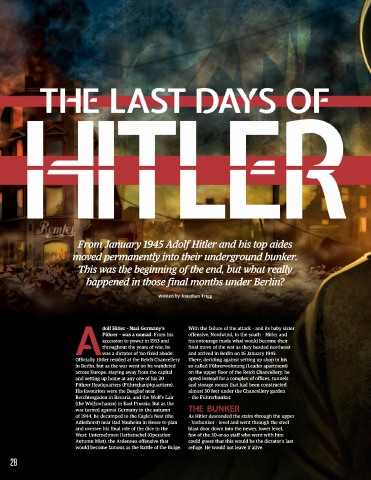
From January 1945 Adolf Hitler and his top aides


                                    moved permanently into their underground bunker.

                                       This was the beginning of the end, but what really


                                          happened in those final months under Berlin?


                                                                             Written by Jonathan Trigg


                                                  dolf Hitler – Nazi Germany’s             With the failure of the attack – and its baby sister
                                                  Führer – was a nomad. From his           offensive, Nordwind, to the south – Hitler and
                                                  accession to power in 1933 and           his entourage made what would become their
                                                  throughout the years of war, he          final move of the war as they headed northeast
                                                  was a dictator of ‘no fixed abode’.      and arrived in Berlin on 16 January 1945.
                                     Officially Hitler resided at the Reich Chancellery    There, deciding against setting up shop in his
                                     in Berlin, but as the war went on he wandered         so-called Führerwohnung (Leader apartment)
                                     across Europe, staying away from the capital          on the upper floor of the Reich Chancellery, he
                                     and setting up home at any one of his 20              opted instead for a complex of offices, tunnels
                                     Führer Headquarters (Führerhauptquartiere).           and storage rooms that had been constructed
                                     His favourites were the Berghof near                  almost 30 feet under the Chancellery garden
                                     Berchtesgaden in Bavaria, and the Wolf’s Lair         – the Führerbunker.
                                     (the Wolfsschanze) in East Prussia. But as the
                                     war turned against Germany in the autumn
                                     of 1944, he decamped to the Eagle’s Nest (the         As Hitler descended the stairs through the upper
                                     Adlerhorst) near Bad Nauheim in Hesse to plan         – Vorbunker – level and went through the steel
                                     and oversee his final role of the dice in the         blast door down into the newer, lower level,
                                     West: Unternehmen Herbstnebel (Operation              few of the 30-or-so staff who went with him
                                     Autumn Mist), the Ardennes offensive that             could guess that this would be the dictator’s last
                                     would become famous as the Battle of the Bulge.       refuge. He would not leave it alive.


      28

