


Page 31 - All About History - Issue 186-19
P. 31
The Last Days Of Hitler


                                        Hitler’s last hiding place was bomb-proof and blast-proof, but couldn’t shield
                                               the dictator from the disaster that was overtaking his capital city


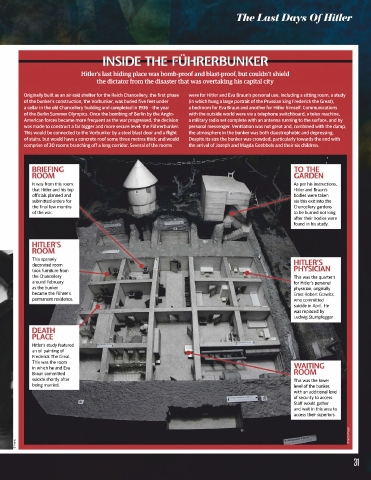
             Originally built as an air-raid shelter for the Reich Chancellery, the first phase   were for Hitler and Eva Braun’s personal use, including a sitting room, a study
             of the bunker’s construction, the Vorbunker, was buried five feet under       (in which hung a large portrait of the Prussian king Frederick the Great),
             a cellar in the old Chancellery building and completed in 1936 – the year     a bedroom for Eva Braun and another for Hitler himself. Communications
             of the Berlin Summer Olympics. Once the bombing of Berlin by the Anglo-       with the outside world were via a telephone switchboard, a telex machine,
             American forces became more frequent as the war progressed, the decision      a military radio set complete with an antenna running to the surface, and by
             was made to construct a far bigger and more secure level: the Führerbunker.   personal messenger. Ventilation was not great and, combined with the damp,
             This would be connected to the Vorbunker by a steel blast door and a flight   the atmosphere in the bunker was both claustrophobic and depressing.
             of stairs, but would have a concrete roof some three metres thick and would   Despite its size the bunker was crowded, particularly towards the end with
             comprise of 30 rooms branching off a long corridor. Several of the rooms      the arrival of Joseph and Magda Goebbels and their six children.


                 It was from this room                                                                                                        As per his instructions,
                 that Hitler and his top                                                                                                      Hitler and Braun’s
                 officials planned and                                                                                                        bodies were taken
                 submitted orders for                                                                                                         via this exit into the
                 the final few months                                                                                                         Chancellery gardens
                 of the war.                                                                                                                  to be burned not long
                                                                                                                                              after their bodies were
                                                                                                                                              found in his study.


                 This sparsely
                 decorated room
                 took furniture from
                 the Chancellery                                                                                                              This was the quarter’s
                 around February                                                                                                              for Hitler’s personal
                 as the bunker                                                                                                                physician, originally
                 became the Führer’s                                                                                                          Ernst-Robert Grawitz,
                 permanent residence.                                                                                                         who committed
                                                                                                                                              suicide in April. He
                                                                                                                                              was replaced by
                                                                                                                                              Ludwig Stumpfegger.


                 Hitler’s study featured
                 an oil painting of
                 Frederick The Great.
                 This was the room
                 in which he and Eva
                 Braun committed
                 suicide shortly after                                                                                                        This was the lower
                 being married.                                                                                                               level of the bunker,
                                                                                                                                              with an additional level
                                                                                                                                              of security to access.
                                                                                                                                              Staff would gather
                                                                                                                                              and wait in this area to
                                                                                                                                              access their superiors.


                                                                                                                                                                        © Getty Images

        © Alamy


                                                                                                                                                                           31

