


Page 36 - (DK Eyewitness) Top 10 Travel Guide - St. Petersburg
P. 36
34  ❯❯  Top 10 St Petersburg Highlights

               Pavlovsk

     Pavlovsk, an 18th-century park and palace ensemble, is notable
     for its atmospheric landscaped grounds, containing temples,
     pavilions and stone bridges. Catherine the Great gave the estate to
     her son, the future Paul I, in 1777 and Pavlovsk (from “Pavel” or
     Paul) was named in his honour. Architect Charles Cameron was
     commissioned to begin work on it in 1780, and Paul I’s wife, Maria
     Fyodorovna, was the driving force behind the development of the
     palace’s exhaustive collections. Maria, being infatuated with both
     Pavlovsk and Europe, travelled with Paul through  out the continent,
     bringing back many sculptures, paintings and silk sets.

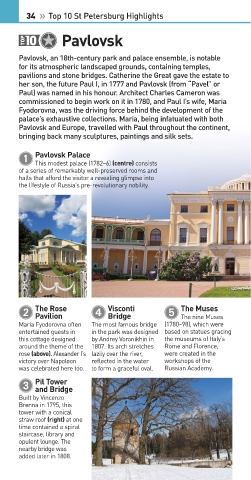
         Pavlovsk Palace
     1
         This modest palace (1782–6) (centre) consists
     of a series of remarkably well-preserved rooms and
     halls that afford the visitor a revealing glimpse into
     the lifestyle of Russia’s pre-revolutionary nobility.


                                          The Muses
                         Visconti
         The Rose
     2                4               5
         Pavilion
                         Bridge
                                          The nine Muses
     Maria Fyodorovna often   The most famous bridge   (1780–98), which were
     enter tained guests in   in the park was de  signed   based on statues gracing
     this cottage designed   by Andrey Voronikhin in   the mu  seums of Italy’s
     around the theme of the  1807. Its arch stretches   Rome and Florence,
     rose (above). Alexander I’s  lazily over the river,   were created in the
     vic tory over Napoleon   reflected in the water    workshops of the
     was celebrated here too.  to form a graceful oval.  Russian Academy.
         Pil Tower
     3
         and Bridge
     Built by Vincenzo
     Brenna in 1795, this
     tower with a conical
     straw roof (right) at one
     time contained a spiral
     stair case, library and
     opulent lounge. The
     nearby bridge was
     added later in 1808.


 034-035_Top_10_St-Petersburg.indd   34               10/10/2016   11:59

