


Page 21 - History of War - Issue 10-14
P. 21
EVOLUTION OF GRENADES


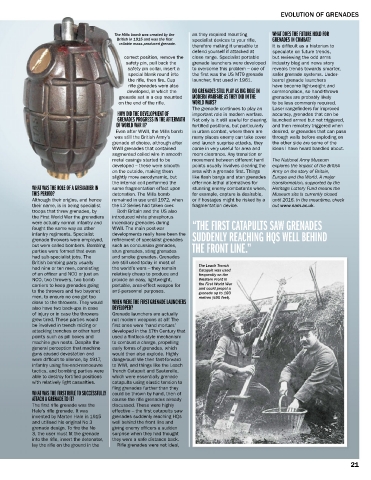
                                         TheMillsbombwascreatedbythe  as they required mounting   WHAT DOES THE FUTURE HOLD FOR
                                          Britishin1915andwasthefirst  specialist devices to your rifl e,   GRENADES IN COMBAT?
                                           reliable mass-produced grenade.
                                                                     therefore making it unusable to   It is diffi cult as a historian to
                                                                     defend yourself if attacked at   speculate on future trends,
                                             correct position, remove the   close range. Specialist portable   but reviewing the odd arms
                                             safety pin, pull back the   grenade launchers were developed   industry blog and news story
                                              safety pin collar, insert a   to overcome this problem – one of   reveals trends towards smarter,
                                              special blank round into   the fi rst was the US M79 grenade   safer grenade systems. Under-
                                              the rifl e, then fi re. Cup   launcher, fi rst used in 1961.  barrel grenade launchers
                                              rifle grenades were also                           have become lightweight and
                                              developed, in which the   DO GRENADES STILL PLAY AS BIG ROLE IN   commonplace, so hand-thrown
                                           grenade sat in a cup mounted   MODERN WARFARE AS THEY DID IN THE   grenades are probably likely
                                           on the end of the rifl e.   WORLD WARS?               to be less commonly required.
                                                                     The grenade continues to play an   Laser rangefi nders for improved
                                          HOWDIDTHE DEVELOPMENT OF   important role in modern warfare.   accuracy, grenades that can be
                                          GRENADESPROGRESS IN THE AFTERMATH   Not only is it still useful for clearing  launched armed but not triggered,
                                          OFWORLDWAR II?             fortifi ed positions, but particularly   and then remotely triggered when
                                          Even after WWII, the Mills bomb   in urban combat, where there are   desired, or grenades that can pass
                                         was still the British Army’s   many places enemy can take cover   through walls before exploding on
                                        grenade of choice, although after   and launch surprise attacks, they   the other side are some of the
                                        WWII grenades that contained   come in very useful for area and   ideas I have heard bandied about.
                                        segmented coiled wire in smooth   room clearance. Any transition or
                                        metal casings started to be   movement between different hard   The National Army Museum
                                        developed – these were smooth   points usually involves clearing the   explores the impact of the British
                                        on the outside, making them   area with a grenade fi rst. Things   Army on the story of Britain,
                                        slightly more aerodynamic, but   like fl ash bangs and stun grenades   Europe and the World. A major
                                        the internal coil performed the   offer non-lethal alternatives for   transformation, supported by the
            WHAT WAS THE ROLE OF A GRENADIER IN   same fragmentation effect upon   stunning enemy combatants when,   Heritage Lottery Fund means the
            THIS PERIOD?                detonation. The Mills bomb   for example, capture is desirable,   Museum site is currently closed
            Although their origins, and hence   remained in use until 1972, when   or if hostages might be risked by a   until 2016. In the meantime, check
            their name, is in being specialist   the L2 Series had taken over.   fragmentation device.   out www.nam.ac.uk.
            troops that threw grenades, by   Both Britain and the US also
            the First World War the grenadiers   introduced white phosphorus
            were actually normal infantry and   incendiary grenades during   “THE FIRST CATAPULTS SAW GRENADES
            fought the same way as other   WWII. The main post-war
            infantry regiments. Specialist   developments really have been the   SUDDENLY REACHING HQS WELL BEHIND
            grenade throwers were employed,   refi nement of specialist grenades
            but were called bombers. Bombing   such as concussion grenades,   THE FRONT LINE.”
            parties were formed that even   stun grenades, sting grenades
            had sub-specialist jobs. The   and smoke grenades. Grenades
            British bombing party usually   are still used today in most of
                                                                       The Leach Trench
            had nine or ten men, consisting   the world’s wars – they remain
                                                                       Catapult was used
            of an offi cer and NCO or just an   relatively cheap to produce and   frequently on the
            NCO, two throwers, two bomb   provide an easy, lightweight,   Western Front in
            carriers to keep grenades going   portable, area-effect weapon for   the First World War
                                                                       and could propel a
            to the throwers and two bayonet   anti-personnel purposes.
                                                                       grenade up to 180
            men, to ensure no one got too                              metres (590 feet).
            close to the throwers. They would   WHEN WERE THE FIRST GRENADE LAUNCHERS
            also have two back-ups in case   DEVELOPED?
            of injury or in case the throwers   Grenade launchers are actually
            grew tired. These parties would   not modern weapons at all! The
            be involved in trench raiding or   fi rst ones were ‘hand mortars’
            attacking trenches or other hard   developed in the 17th Century that
            points such as pill boxes and   used a fl intlock-style mechanism
            machine gun nests. Despite the   to combust a charge, propelling
            general perception that machine   early forms of grenades, which
            guns caused devastation and   would then also explode. Highly
            were diffi cult to silence, by 1917,   dangerous! We then fast-forward
            infantry using fi re-and-manoeuvre   to WWI, and things like the Leach
            tactics, and bombing parties were   Trench Catapult and Sauterelle,
            able to destroy fortifi ed positions   which were essentially grenade
            with relatively light casualties.   catapults using elastic tension to
                                        fl ing grenades further than they
            WHAT WAS THE FIRST RIFLE TO SUCCESSFULLY   could be thrown by hand, then of
            ATTACH A GRENADE TO IT?     course the rifl e grenades already
            The fi rst rifl e grenade was the   discussed. These were highly
            Hale’s rifl e grenade. It was   effective – the fi rst catapults saw
            invented by Marten Hale in 1915   grenades suddenly reaching HQs
            and utilised his original No 3   well behind the front line and
            grenade design. To fi re the No   giving enemy offi cers a sudden
            3, the user must fi t the grenade   surprise when they had thought
            into the rifl e, insert the detonator,   they were a safe distance back.
            lay the rifl e on the ground in the   Rifl e grenades were not ideal,


                                                                                                                            21

