


Page 66 - History of War - Issue 10-14
P. 66
BRIEFING


          The Iraqi monarchy 1922-1958         and Shia anger against a Sunni-dominated   with the disastrous attack on Eygpt by Britain,
          Differences between the Sunnis and Shias   government percieved to be acting firmly in   France and Israel in the 1956 Suez Crisis,
          are believed to have originally begun in 66 CE   the British interest. Led by Arab nationalist   crippled Faisal’s rule, but the final straw came
          when the Sunni-dominated Umayyad Caliphate   General Bakr Sidqi, the revolt was against the   when the King opposed a plan to establish
          failed in its attempts to turn Iraq into a unified   authoritarianism of the regime and severely   the United Arab Republic of Egypt and Syria.
          political community. Sympathy for ISIS’s goals   weakened the constitution. This would open   He was assassinated in July 1958 during the
          has its deepest roots here in this division, but   the door to the future disabling of the Iraqi elite   14 July Revolution after losing control of both
          sectarian notions were revived after the fall   and weaken the state. This era also signalled   the people and the military. The interference
          of the Ottoman Empire. The resulting power   the end of the Assyrian voice in Iraq as the   of Western powers had now been effectively
          vacuum led to Western powers, especially the   small minority was reduced further after a   diminished in the country and the Iraq Republic
          French and British, establishing rule over areas   1933 massacre by Iraqi and Kurdish forces   was born. This event would go to show that
          of the Middle East, including Iraq. King Faisal   that killed 3,000 men, women and children.   Western intrusion was far from popular and
          I, who had previously been ousted from rule in   The Assyrians, aside from being a Christian   although Britain justified reasons for its
          Syria, began the House of Hashemite line in   community that nursed a centuries-old feud   involvement, an anti-Western feeling was
          Iraq. Naturally a ruler installed by the British   with the neighbouring Kurds, had served the   rapidly assembling and the extremist seeds
          wasn’t overly popular and seven military coups   British in suppressing Arab revolts.  had been sown.
          were attempted during his reign. Faisal died   Despite the various coups cracking its
          in 1933 and was replaced by his son Ghazi   foundations, the monarchy staggered on under  Birth of a republic 1958-1979
          bin Faisal – a Nazi sympathiser with a love of   King Faisal II (1953-1958). It encountered   The 14 July Revolution in 1958 marked the end
          fast cars. He proved to be just as unpopular   trouble again in 1955 after the Baghdad   of the monarchy and the beginning of the Iraq
          – a fact illustrated in the 1936 coup d’état.   Pact, designed to form a pro-Western military   Republic. The new prime minister was Abdul-
          This was the first of its kind in the modern   agreement between Turkey, Iraq, Iran, Pakistan,   Karim Qasim, while Muhammad Najib Ar-Ruba’I
          Arab world and represented the Kurdish   and the United Kingdom, faltered. This, coupled   assumed the presidency. Both were Sunni


                                                In July 1958, Colonel Aref and General Abdul
                                                Karim Qasim overthrew the ruling monarchy in
                                                a coup d’etat, and took control of the new Iraqi


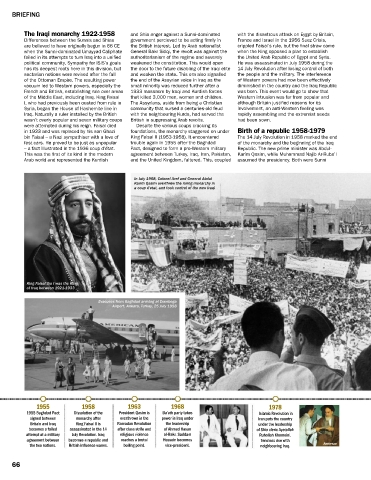
          King Faisal the I was the King
          of Iraq between 1921-1933

                                    Evacuees from Baghdad arriving at Esenboga
                                        Airport, Ankara, Turkey, 25 July 1958


              1955            1958            1963           1968                              1978
          1955 Baghdad Pact   Dissolution of the  PresidentQasimis  Ba’ath party takes       Islamic Revolution in
            signed between   monarchy after  overthrown in the  powerinIraqunder            Iran puts the country
            Britain and Iraq   King Faisal II is  Ramadan Revolution  the leadership        under the leadership
           becomes a failed   assassinated in the 14  after class strife and  of Ahmad Hasan  of Shia cleric Ayatollah
          attemptatamilitary   July Revolution. Iraq  religious violence  al-Bakr. Saddam   Ruhollah Khomeini.
          agreement between   becomes a republic and  reaches a brutal  Hussein becomes      Tensions rise with
            the two nations.  British influence wanes.  boiling point.  vice-president.      neighbouring Iraq.    Amirreza


     66

