


Page 70 - History of War - Issue 10-14
P. 70
White House


                            declassifi ed


          A memorandum of a conversation between US President Gerald Ford
          and Senator James William Fulbright on Wednesday 2 July 1975,

          discussing the situation in the Middle East

               y 1975 there had already been four
               wars between Israel and Arab nations
         B since the turn of the century. The most
          recent was the 1973 Arab-Israeli War, where
          Egyptian and Syrian forces surrounded Israel
          but were eventually pushed back by an Israeli
          counterattack. A ceasefi re was signed on 18
          January 1974 but tensions still ran high. A
          year later, Israeli Prime Minister Yitzhak Rabin
          rejected an Egyptian offer of a peace accord.
          As a result, offi cials from both the United
          Nations and United States were called in to
          help smooth negotiations. These diplomats
          included the now legendary fi gure Henry
          Kissinger and little-known US senator James
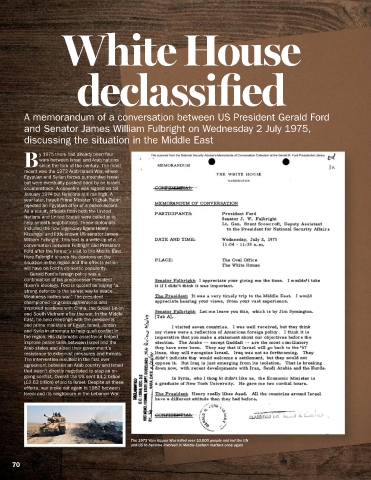
          William Fulbright. This text is a write-up of a
          conversation between Fulbright and President
          Ford after the former’s visit to the Middle East.
          Here Fulbright shares his opinions on the
          situation in the region and the effects action
          will have on Ford’s domestic popularity.
            Gerald Ford’s foreign policy was a
          continuation of his predecessor President
          Nixon’s ideology. Ford is quoted as saying “a
          strong defence is the surest way to peace…
          Weakness invites war.” The president
          championed long-term agreements and
          improved relations with China, the Soviet Union
          and South Vietnam after the war. In the Middle
          East, he held meetings with the presidents
          and prime ministers of Egypt, Israel, Jordan
          and Syria in attempts to help quell confl ict in
          the region. His diplomatic assistance helped
          improve peace talks between Israel and the
          Arab states and aided their government’s
          resistance to extremist pressures and threats.
          The intervention resulted in the fi rst ever
          agreement between an Arab country and Israel
          that wasn’t directly negotiated to stop an on-
          going confl ict. Overall the US sent $4.2 billion
          (£2.63 billion) of aid to Israel. Despite all these
          efforts, war broke out again in 1982 between
          Isreal and its neighbours in the Lebanon War.


                                               The 1973 Yom Kippur War killed over 10,000 people and led the UN
                                               and US to become involved in Middle Eastern matters once again


     70

