


Page 84 - History of War - Issue 10-14
P. 84
VIETNAM: THE UNTOLD STORY


                                                 CHINAANDVIETNAM


                                                 CHINESE INFLUENCE AND PRESENCE IN VIETNAM STRETCHES BACK BEYOND 111 BCE
                                                 ANDTHETWOCOUNTRIES’HISTORIESAREINTERTWINED IN A LEGACY OF INVASIONS,
                                                 RESISTANCE, AS WELL AS CULTURAL AND POLITICAL EXCHANGE

                                                 China had long been involved with Vietnam  rule itself. Rebellions challenged Chinese rule
                                                 before it came to rule it. For a hundred years the  repeatedly, and Vietnam managed to snatch
                                                 twonationsengagedinbattlesuntilthecountry  its independence several times before it was
                                                 wasfinallyconqueredbytheHanDynastyin111  conquered again and again by different Chinese
                                                 BCE. China was quick to put its stamp on the  dynasties – from the Han to the Tran to Sui to
                                                 land, which became divided into nine districts  Tang. Vietnamese insurrections erupted out
                                                 – all with Chinese names. This acculturation  of any disturbance or decline in the dynasties,
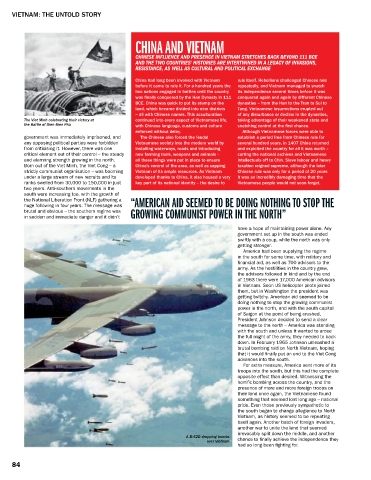
          The Viet Minh celebrating their victory at   continuedintoeveryaspectofVietnameselife,  taking advantage of their weakened state and
          the Battle of Dien Bien Phu            with Chinese language, customs and culture  snatching control at the fi rst chance.
                                                 enforced without delay.              Although Vietnamese forces were able to
          government was immediately imprisoned, and  The Chinese also forced the feudal  establish a period free from Chinese rule for
          anyopposingpoliticalpartieswereforbidden  Vietnamese society into the modern world by  several hundred years, in 1407 China returned
          from criticising it. However, there was one  installing waterways, roads and introducing  and exploited the country for all it was worth –
          critical element out of their control – the steady  new farming tools, weapons and animals –  carting the national archives and Vietnamese
          andalarmingstrengthgrowinginthenorth.  all these things were put in place to ensure  intellectuals off to Chin. Slave labour and heavy
          BornoutoftheVietMinh,theVietCong–a     China’s control of the area, as well as sapping  taxation reigned supreme, although the later
          strictly communist organisation – was booming  Vietnam of its ample resources. As Vietnam  Chinese rule was only for a period of 20 years
          under a large stream of new recruits and its  developed thanks to China, it also housed a very  it was an incredibly damaging time that the
          ranks swelled from 30,000 to 150,000 in just  key part of its national identity – the desire to  Vietnamese people would not soon forget.
          two years. Anti-southern movements in the
          south were increasing too, with the growth of
          hugefollowinginfouryears.Themessagewas “AMERICAN AID SEEMED TO BE DOING NOTHING TO STOP THE
          theNationalLiberationFront(NLF)gatheringa
          in sudden and immediate danger and it didn’t GROWING COMMUNIST POWER IN THE NORTH”
          brutalandobvious–thesouthernregimewas


                                                                                     have a hope of maintaining power alone. Any
                                                                                     government set up in the south was ended
                                                                                     swiftly with a coup, while the north was only
                                                                                     getting stronger.
                                                                                       America had been supplying the regime
                                                                                     in the south for some time, with military and
                                                                                     fi nancial aid, as well as 700 advisors to the
                                                                                     army. As the hostilities in the country grew,
                                                                                     the advisors followed in kind and by the end
                                                                                     of 1963 there were 17,000 American advisors
                                                                                     in Vietnam. Soon US helicopter pilots joined
                                                                                     them, but in Washington the president was
                                                                                     getting twitchy. American aid seemed to be
                                                                                     doing nothing to stop the growing communist
                                                                                     power in the north, and with the south capital
                                                                                     of Saigon at the point of being crushed,
                                                                                     President Johnson decided to send a clear
                                                                                     message to the north – America was standing
                                                                                     with the south and unless it wanted to arose
                                                                                     the full might of the army, they needed to back
                                                                                     down. In February 1965 Johnson unleashed a
                                                                                     brutal bombing raid on North Vietnam, hoping
                                                                                     that it would fi nally put an end to the Viet Cong
                                                                                     advances into the south.
                                                                                       For extra measure, America sent more of its
                                                                                     troops into the south, but this had the complete
                                                                                     opposite effect than desired. Witnessing the
                                                                                     horrifi c bombing across the country, and the
                                                                                     presence of more and more foreign troops on
                                                                                     their land once again, the Vietnamese found
                                                                                     something that seemed lost long ago – national
                                                                                     pride. Even those previously sympathetic to
                                                                                     the south began to change allegiance to North
                                                                                     Vietnam, as history seemed to be repeating
                                                                                     itself again. Another batch of foreign invaders,
                                                                                     another war to unite the land that seemed
                                                                                     irrevocably split down the middle, and another
                                                                  A B-52D dropping bombs
                                                                          over Vietnam  chance to fi nally achieve the independence they
                                                                                     had so long been fi ghting for.

     84

