


Page 89 - History of War - Issue 10-14
P. 89
TIGER I


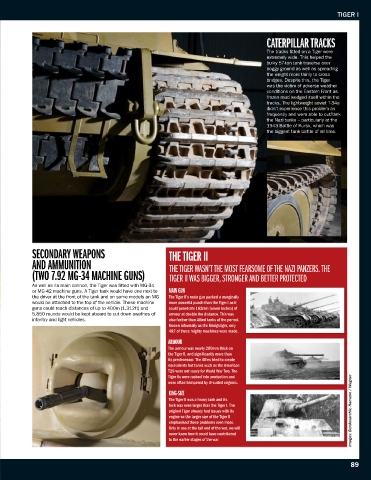
                                                                                               CATERPILLAR TRACKS

                                                                                               The tracks fi tted on a Tiger were
                                                                                               extremely wide. This helped the
                                                                                               bulky 57-ton tank traverse over
                                                                                               boggy ground as well as spreading
                                                                                               the weight more thinly to cross
                                                                                               bridges. Despite this, the Tiger
                                                                                               was the victim of adverse weather
                                                                                               conditions on the Eastern Front as
                                                                                               frozen mud wedged itself within the
                                                                                               tracks. The lightweight soviet T-34s
                                                                                               didn’t experience this problem as
                                                                                               frequently and were able to outfl ank
                                                                                               the Nazi tanks – particularly at the
                                                                                               1943 Battle of Kursk, which was
                                                                                               the biggest tank battle of all time.


            SECONDARY WEAPONS                               THE TIGER II
            AND AMMUNITION                                   THE TIGER WASN’T THE MOST FEARSOMEOFTHENAZIPANZERS.THE

            (TWO 7.92 MG-34 MACHINE GUNS)                    TIGER II WAS BIGGER, STRONGER ANDBETTERPROTECTED

            As well as its main cannon, the Tiger was fi tted with MG-34
            or MG-42 machine guns. A Tiger tank would have one next to   MAIN GUN
            the driver at the front of the tank and on some models an MG   The Tiger II’s main gun packed a marginally
            would be attached to the top of the vehicle. These machine   more powerful punch than the Tiger I as it
            guns could reach distances of up to 400m (1,312ft) and   could penetrate 182mm (seven inches) of
            5,850 rounds would be kept aboard to cut down swathes of   armour at double the distance. This was
            infantry and light vehicles.                    also further than Allied tanks of the period.
                                                            Known informally as the Königstiger, only
                                                            492 of these mighty machines were made.
                                                            ARMOUR
                                                            The armour was nearly 200mm thick on
                                                            the Tiger II, and signifi cantly more than
                                                            its predecessor. The Allies tried to create
                                                            equivalents but tanks such as the American
                                                            T29 were not ready for World War Two. The
                                                            Tiger IIs were rushed into production and
                                                            were often hampered by ill-suited engines.
                                                            KING-SIZE
                                                            The Tiger II was a heavy tank and its
                                                            bulk was even larger than the Tiger I. The
                                                            original Tiger already had issues with its                      Images: Bundesarchiv, Hamann / Wagner
                                                            engine so the larger size of the Tiger II
                                                            emphasised these problems even more.
                                                            Only in use at the tail end of the war, we will
                                                            never know how it could have contributed
                                                            to the earlier stages of the war.


                                                                                                                            89

