


Page 130 - (DK Eyewitness) Travel Guide - Germany
P. 130
128 EASTERN GERM AN Y INTRODUCING EASTERN GERM AN Y 129
Meissen Porcelain
Tableware Marks on
Until the early 18th century the only porcelain In the second half of the 18th and in the Meissen Porcelain
known in Europe was that imported from the Far 19th centuries, porcelain manufacturers All porcelain manufacturers
East, and the Chinese jealously guarded the secrets developed their own designs. This proved so mark their products with their
of its production. Finally, in 1707, Johann Friedrich popular that some remain in production to own symbols. The symbols
are generally applied under
Böttger and Ehrenfried Walther von Tschirnhaus this day. The best-known Meissen designs the glaze, at the bottom
are the “vine-leaves” and the “onion” patterns,
succeeded in developing a recipe that made it first introduced in the 18th century. of the piece. The Meissen
possible to produce genuine porcelain. A factory Customers can thus still replace items factory initially used marks
was set up in Meissen, and from 1713 it began to in the services that have graced that imitated Japanese or
Chinese writing; later, for
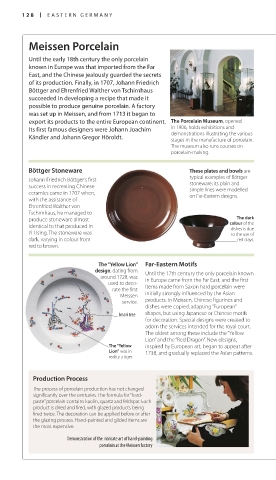
export its products to the entire European continent. The Porcelain Museum, opened their family tables for generations. a short time, letters were
Its first famous designers were Johann Joachim in 1906, holds exhibitions and used, and from 1724 blue
demonstrations illustrating the various
Kändler and Johann Gregor Höroldt. stages in the manufacture of porcelain. This coffee pot and cup is decorated trademarks in the shape of
with the cobalt “onion” pattern,
The museum also runs courses on depicting stylized pomegranate fruits. crossed swords became the
standard mark. The last three
porcelain-making.
symbols below identify the
Fine-Art Motifs respective court for which
Böttger Stoneware These plates and bowls are A new type of decoration, which became popular in the second each piece of porcelain
was produced.
Johann Friedrich Böttger’s first typical examples of Böttger half of the 18th century, involved the accurate copying of famous
stoneware; its plain and
success in recreating Chinese simple lines were modelled paintings or etchings onto a vase, a pot or a plate. This type of
ceramics came in 1707 when, on Far-Eastern designs. decoration proved particularly
with the assistance of popular during the
Ehrenfried Walther von Classicist period.
Tschirnhaus, he managed to Königliche Porzellan-Fabrik,
The dark
produce stoneware almost colour of the trademark used in 1723
identical to that produced in dishes is due
Yi Hsing. The stoneware was to the use of
dark, varying in colour from red clays.
red to brown.
The “Yellow Lion” Far-Eastern Motifs Königliche Porzellan-Manufaktur,
design, dating from Until the 17th century the only porcelain known Decorator copying an etching onto trademark used in 1723–4
around 1728, was in Europe came from the Far East, and the first a vessel
used to deco-
rate the first items made from Saxon hard porcelain were Vase decorated with a miniature of
Meissen initially strongly influenced by the Asian a painting by Antoine Watteau
service. products. In Meissen, Chinese figurines and
dishes were copied, adapting “European” Trademarks used from 1724
Imari tree shapes, but using Japanese or Chinese motifs Services and Figurines
for decoration. Special designs were created to Several outstanding sculptors and painters
adorn the services intended for the royal court. were employed in the Meissen porcelain
The oldest among these include the “Yellow manufacture to design unique services
Lion” and the “Red Dragon”. New designs,
The “Yellow inspired by European art, began to appear after and figurines for the royal courts. The
Lion” was in 1738, and gradually replaced the Asian patterns. most famous among them are the
reality a tiger. services designed by Johann Joachim Augustus Rex, the initials of
Kändler. He also created sets of figurines to King August
adorn dining tables, vases and
Production Process censers (containers for burning
incense) for decorating the
The process of porcelain production has not changed home, and large religious “Swan” Service Tureen
significantly over the centuries. The formula for “hard- compositions for churches.
paste” porcelain contains kaolin, quartz and feldspar. Each Königliche Hof-Küche
product is dried and fired, with glazed products being
fired twice. The decoration can be applied before or after
the glazing process. Hand-painted and gilded items are Figurine of August III
the most expensive.
Demonstration of the intricate art of hand-painting Europa, a figure from the Königliche
porcelain at the Meissen factory “Four Continents” series, Hof-Conditorei Warschau
designed by J J Kändler
128-129_EW_Germany.indd 128 09/10/17 12:58 pm 128-129_EW_Germany.indd 129 09/10/17 12:58 pm
Eyewitness Travel LAYERS PRINTED:
Feature template “UK” LAYER
(SourceReport v1.3)
Date 18th October 2012
Size 125mm x 217mm

