


Page 132 - (DK Eyewitness) Travel Guide - Germany
P. 132
130 EASTERN GERM AN Y INTRODUCING EASTERN GERM AN Y 131
Luther and the Reformation Luther’s Room (Lutherstube), shown here, is part
of Luther’s House in Wittenberg (see p158). The
In 1517, on the eve of All Saints’ Day (31 October), famous reformer lived here with his wife and family.
Martin Luther nailed his 95 “theses” to the doors
of the castle church in Wittenberg, condemning
the practice of indulgences. His subsequent
pronouncements, in which he criticized many
aspects of the Church’s teaching, made him the
“father” of the Reformation movement in Germany
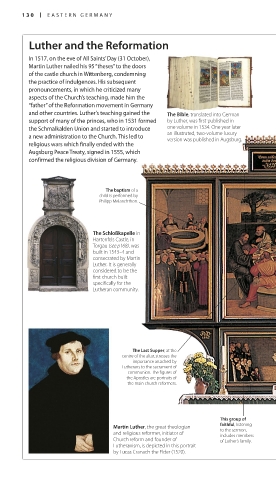
and other countries. Luther’s teaching gained the The Bible, translated into German
support of many of the princes, who in 1531 formed by Luther, was first published in
the Schmalkalden Union and started to introduce one volume in 1534. One year later
a new administration to the Church. This led to an illustrated, two-volume luxury Cup Bearer Serving at the Table
version was published in Augsburg.
religious wars which finally ended with the is the title of a portrait by Lucas
Cranach the Younger.
Augsburg Peace Treaty, signed in 1555, which
confirmed the religious division of Germany.
The baptism of a Philipp Melanchthon, an associate
child is performed by of Luther’s and the co-founder of
Philipp Melanchthon. Lutheranism, initiated a great
educational reform. He was also
known as praeceptor Germaniae,
Germany’s teacher.
The Schloßkapelle in
Hartenfels Castle, in Reformation Altar
Torgau (see p168), was The main altar of St Mary’s Church in
built in 1543–4 and Wittenberg (see pp158–9) is one of the
consecrated by Martin most important works of art of the
Luther. It is generally
considered to be the Reformation period. The central picture
first church built was painted by Lucas Cranach the Elder
specifically for the (around 1539), the wings by his son,
Lutheran community. Lucas Cranach the Younger, before 1547.
Protestant confession
The Last Supper, at the is taken by Johannes
centre of the altar, stresses the Bugenhagen.
importance attached by
Lutherans to the sacrament of
communion. The figures of
the Apostles are portraits of
the main church reformers.
This group of
Martin Luther, the great theologian faithful, listening Sermon preached by Martin Katharina von Bora, a former nun,
to the sermon,
and religious reformer, initiator of includes members Luther, who points to the became Martin Luther’s wife in
Church reform and founder of of Luther’s family. figure of the crucified Christ. 1525. She lies buried in the
Lutheranism, is depicted in this portrait Marienkirche in Torgau (see p168), in
by Lucas Cranach the Elder (1520). a tomb which survives to this day.
130-131_EW_Germany.indd 130 09/10/17 12:58 pm 130-131_EW_Germany.indd 131 09/10/17 12:58 pm
Eyewitness Travel LAYERS PRINTED:
Feature template “UK” LAYER
(SourceReport v1.3)
Date 18th October 2012
Size 125mm x 217mm

