


Page 194 - (DK Eyewitness) Travel Guide - Germany
P. 194
192 EASTERN GERM AN Y THURINGIA 193
2 Heiligenstadt 4 Sondershausen 6 Gotha stands a Neo-Renaissance
building, which was purpose-
Road map C4. * 17,500. £ @ Road map D4. * 23,000. @ Road map D4. * 48,000. £ @ n
n Wilhelmstraße 50 (03606-67 71 n Markt 9 (03632-78 81 11). Hauptmarkt 33 (03621-50 78 57 12). built for the ducal art collection.
41). ∑ heilbad-heiligenstadt.de _ Residenzfest (Jun), Schloßfests piele _ Gothardusfest (May). ∑ gotha.de Now it houses the Museum
(Jul). ∑ sondershausen.de der Natur, a natural history
This pleasant spa and health From 1640 the old commercial museum. The Renaissance town
resort, well placed for visiting Sondershausen was the capital town of Gotha was the capital hall (1567–77) in the old town
the gardens of Eichsfeld, is worth city of the small principality of of Saxe-Gotha and later of is surrounded by a number
an ex tended stop. Heiligenstadt Schwarzburg-Sondershausen. Saxe-Coburg-Gotha Duchy, of interesting houses.
is the birthplace of Tilman The town’s main attraction is the the dynasty from which Prince Gotha played an important
Riemenschneider, an outstanding Schloß (ducal palace), a sprawling Albert, Queen Victoria’s husband, role in the German workers’
sculptor of the Gothic era; it is building built in stages from the descended. The vast ducal movement: the Socialist
also the place where the poet 16th to the 19th century. The palace, Schloß Friedenstein, Workers’ Party (today’s SPD),
and writer Heinrich Heine was palace features some inte resting built in 1643–55, towers above was founded here in 1875.
baptized in 1825, at the age of 28. original interiors. Parti cularly the city. This mighty rectangular The conference hall has
Heiligenstadt has several Part of the well-preserved town walls noteworthy are the Am structure was the first Baroque been reconstructed and
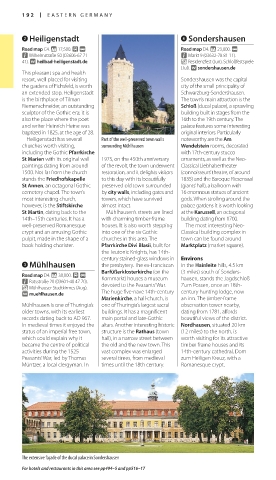
churches worth visiting, surrounding Mühlhausen Wendelstein rooms, decorated Monument to Wilhelm I in the building in Thu ringia. houses the Gedenkstätte
including the Gothic Pfarr kirche with 17th-century stucco Kyffhäuser Mountains Particularly noteworthy are der Deutschen Arbeiter
St Marien with its original wall 1975, on the 450th anniversary ornaments, as well as the Neo- the ballroom, the palace bewegung (memorial to the
paintings dating from around of the revolt, the town underwent Classical Liebhabertheater 5 Kyffhäuser chapel with the ducal sarco- German workers’ movement).
1500. Not far from the church restoration, and it delights visitors (connoisseurs’ theatre, of around Mountains phagi in the crypt and the
stands the Friedhofskapelle to this day with its beautifully 1835) and the Baroque Riesensaal court theatre, built in 1683. The + Schloß Friedenstein
St Annen, an octagonal Gothic preserved old town surrounded (giants’ hall), a ballroom with Road map D4. n Bad Frankenhausen, palace museum houses an art Tel 03621-8234 51. Open May–Oct:
cemetery chapel. The town’s by city walls, including gates and 16 enormous statues of ancient Anger 14 (034671-71 717). collection including works by 10am–5pm Tue–Sun; Nov–Apr:
most interesting church, towers, which have survived gods. When strolling around the famous artists such as Peter Paul 10am–4pm Tue–Sun.
however, is the Stiftskirche almost intact. palace gardens it is worth looking This small mountain range along Rubens, Anton van Dyck, Frans E Gedenkstätte der Deutschen
St Martin, dating back to the Mühlhausen’s streets are lined at the Karussell, an octagonal the border between Thuringia Hals and Jan van Goyen. The Arbeiterbewegung
14th–15th centuries. It has a with charming timber-frame building dating from 1700. and Saxony-Anhalt is not only palace garden is also worth a Am Tivoli 3. Tel (03621) 70 41 27.
well-preserved Romanesque houses. It is also worth stepping The most interesting Neo- picturesque but is also shrouded visit. To the south of the palace Open only by prior arrangement.
crypt and an amusing Gothic into one of the six Gothic Classical building complex in in legends and associated with
pulpit, made in the shape of a churches in this area. The town can be found around important historic events.
book-holding chorister. Pfarrkirche Divi Blasii, built for Marktplatz (market square). According to one legend, the
the Teutonic Knights, has 14th- Emperor Frederick I Barbarossa
century stained-glass windows in Environs found his final resting place in
3 Mühlhausen the presbytery. The ex-Franciscan In the Hainleite hills, 4.5 km one of the caves. Allegedly,
Barfüßer klosterkirche (on the (3 miles) south of Sonders- he did not drown during the
Road map D4. * 38,000. £ @
n Ratsstraße 20 (03601-40 47 70). Kornmarkt) houses a museum hausen, stands the Jagdschloß Crusades, as histo ric records
_ Mühlhauser Stadtkirmes (Aug). devoted to the Peasants’ War. Zum Possen, once an 18th- would have us believe, but is
∑ muehlhausen.de The huge five-nave 14th-century century hunting lodge, now waiting here, in the company of
Marienkirche, a hall-church, is an inn. The timber-frame six knights. As soon as his beard
Mühlhausen is one of Thuringia’s one of Thuringia’s largest sacral observation tower nearby, is long enough to wind three
older towns, with its earliest buildings. It has a magnificent dating from 1781, affords times around the table, it is said,
records dating back to AD 967. main portal and late-Gothic beautiful views of the district. he will return to save Germany
In medieval times it enjoyed the altars. Another interesting historic Nordhausen, situated 20 km from oppression. On the site of
status of an imperial free town, structure is the Rathaus (town (12 miles) to the north, is the former imperial palace now
which could explain why it hall), in a narrow street between worth visiting for its attractive stands a giant monument with
became the centre of political the old and the new town. This timber-frame houses and its a figure of Barbarossa and an
activities during the 1525 vast complex was enlarged 14th-century cathedral, Dom equestrian statue of Emperor
Peasants’ War, led by Thomas several times, from medieval zum Heiligen Kreuz, with a Wilhelm I – the work of Bruno
Müntzer, a local clergyman. In times until the 18th century. Romanesque crypt. Schmitz, erected in 1891–6.
A small health resort, Bad
Frankenhausen, nestles at the
foot of the mountains. It has a
number of Gothic churches,
including Oberkirche, famed for
its leaning tower, and a Renais-
sance palace, now home to a
small museum. Nearby, on the
Schlachtberg (slaughter moun-
tain), the decisive battle in the
Peasants’ War took place. The
Pavilion Museum there holds
a vast panoramic picture of the
The extensive façade of the ducal palace in Sondershausen battle, painted in 1971–5. Doorway of the Renaissance town hall on the Hauptmarkt, in Gotha
For hotels and restaurants in this area see pp494–5 and pp516–17
192-193_EW_Germany.indd 192 09/10/17 12:59 pm 192-193_EW_Germany.indd 193 09/10/17 12:59 pm

