


Page 195 - (DK Eyewitness) Travel Guide - Germany
P. 195
THURINGIA 193
6 Gotha stands a Neo-Renaissance
building, which was purpose-
Road map D4. * 48,000. £ @ n
Hauptmarkt 33 (03621-50 78 57 12). built for the ducal art collection.
_ Gothardusfest (May). ∑ gotha.de Now it houses the Museum
der Natur, a natural history
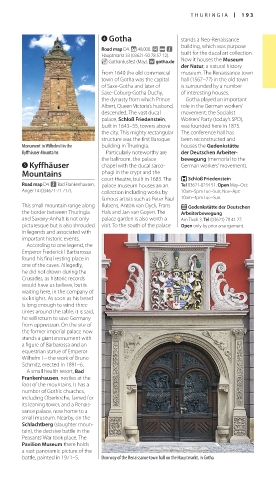
From 1640 the old commercial museum. The Renaissance town
town of Gotha was the capital hall (1567–77) in the old town
of Saxe-Gotha and later of is surrounded by a number
Saxe-Coburg-Gotha Duchy, of interesting houses.
the dynasty from which Prince Gotha played an important
Albert, Queen Victoria’s husband, role in the German workers’
descended. The vast ducal movement: the Socialist
palace, Schloß Friedenstein, Workers’ Party (today’s SPD),
built in 1643–55, towers above was founded here in 1875.
the city. This mighty rectangular The conference hall has
structure was the first Baroque been reconstructed and
Monument to Wilhelm I in the building in Thu ringia. houses the Gedenkstätte
Kyffhäuser Mountains Particularly noteworthy are der Deutschen Arbeiter
the ballroom, the palace bewegung (memorial to the
5 Kyffhäuser chapel with the ducal sarco- German workers’ movement).
Mountains phagi in the crypt and the
court theatre, built in 1683. The + Schloß Friedenstein
Road map D4. n Bad Frankenhausen, palace museum houses an art Tel 03621-8234 51. Open May–Oct:
Anger 14 (034671-71 717). collection including works by 10am–5pm Tue–Sun; Nov–Apr:
famous artists such as Peter Paul 10am–4pm Tue–Sun.
This small mountain range along Rubens, Anton van Dyck, Frans E Gedenkstätte der Deutschen
the border between Thuringia Hals and Jan van Goyen. The Arbeiterbewegung
and Saxony-Anhalt is not only palace garden is also worth a Am Tivoli 3. Tel (03621) 70 41 27.
picturesque but is also shrouded visit. To the south of the palace Open only by prior arrangement.
in legends and associated with
important historic events.
According to one legend, the
Emperor Frederick I Barbarossa
found his final resting place in
one of the caves. Allegedly,
he did not drown during the
Crusades, as histo ric records
would have us believe, but is
waiting here, in the company of
six knights. As soon as his beard
is long enough to wind three
times around the table, it is said,
he will return to save Germany
from oppression. On the site of
the former imperial palace now
stands a giant monument with
a figure of Barbarossa and an
equestrian statue of Emperor
Wilhelm I – the work of Bruno
Schmitz, erected in 1891–6.
A small health resort, Bad
Frankenhausen, nestles at the
foot of the mountains. It has a
number of Gothic churches,
including Oberkirche, famed for
its leaning tower, and a Renais-
sance palace, now home to a
small museum. Nearby, on the
Schlachtberg (slaughter moun-
tain), the decisive battle in the
Peasants’ War took place. The
Pavilion Museum there holds
a vast panoramic picture of the
battle, painted in 1971–5. Doorway of the Renaissance town hall on the Hauptmarkt, in Gotha
192-193_EW_Germany.indd 193 09/10/17 12:59 pm

