


Page 207 - (DK Eyewitness) Travel Guide - Germany
P. 207
INTRODUCING SOUTHERN GERM AN Y 205
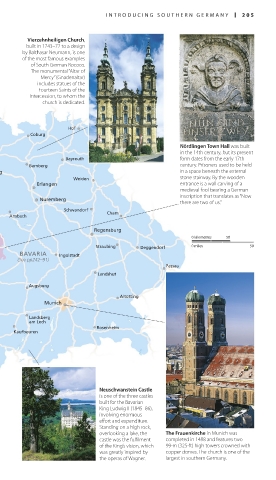
Vierzehnheiligen Church,
built in 1743–72 to a design
by Balthasar Neumann, is one
of the most famous examples
of South German Rococo.
The monumental “Altar of
Mercy” (Gnadenaltar)
includes statues of the
Fourteen Saints of the
Intercession, to whom the
church is dedicated.
Hof
Coburg
Nördlingen Town Hall was built
Aschaffenburg in the 14th century, but its present
Bayreuth form dates from the early 17th
Bamberg century. Prisoners used to be held
Würzburg in a space beneath the external
Weiden stone stairway. By the wooden
Erlangen entrance is a wall carving of a
Mannheim medieval fool bearing a German
Nuremberg inscription that translates as “Now
Heidelberg there are two of us.”
Schwandorf
Ansbach Cham
Karlsruhe Heilbronn Regensburg
0 kilometres 50
Baden- Aalen 0 miles 50
Baden Pforzheim Stuttgart Straubing Deggendorf
BAVARIA Ingolstadt
(See pp242–91)
Passau
Reutlingen Landshut
Offenburg
BADEN- Ulm Augsburg
WÜRTTEMBERG
(See pp292–331) Altötting
Munich
Biberach
Freiburg Landsberg
in Breisgau Tuttlingen am Lech
Rosenheim
Kaufbeuren
Schaffhausen Kempten
Konstanz
Neuschwanstein Castle
is one of the three castles
built for the Bavarian
King Ludwig II (1845–86),
involving enormous
effort and expenditure.
Standing on a high rock,
overlooking a lake, the The Frauenkirche in Munich was
castle was the fulfilment completed in 1488 and features two
of the King’s vision, which 99-m (325-ft) high towers crowned with
was greatly inspired by copper domes. The church is one of the
the operas of Wagner. largest in southern Germany.
204-205_EW_Germany.indd 205 09/10/17 12:59 pm

