


Page 208 - (DK Eyewitness) Travel Guide - Germany
P. 208
206 SOUTHERN GERM AN Y INTRODUCING SOUTHERN GERM AN Y 207
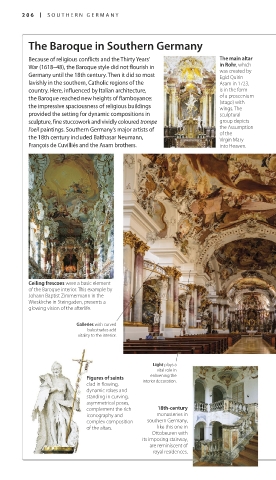
The Baroque in Southern Germany Late Baroque church
façades, such as that of the Baroque Residences
Because of religious conflicts and the Thirty Years’ The main altar Theatiner kirche in Munich, South German Baroque was
War (1618–48), the Baroque style did not flourish in in Rohr, which have a “rippled” design that not limited solely to religious
creates an unusual effect
was created by
Germany until the 18th century. Then it did so most Egid Quirin of light and shadow. architecture. As well as the
magnificent monasteries and
lavishly in the southern, Catholic regions of the Asam in 1723, pilgrimage churches, it was
country. Here, influenced by Italian architecture, is in the form also the inspiration for the
the Baroque reached new heights of flamboyance: of a proscenium impressive residences that
(stage) with
the impressive spaciousness of religious buildings wings. The were built by abbots, as
well as by bishops. As in
provided the setting for dynamic compositions in sculptural the rest of Europe, these
sculpture, fine stuccowork and vividly coloured trompe group depicts were modelled on the
l’oeil paintings. Southern Germany’s major artists of the Assumption French royal palace in
of the
the 18th century included Balthasar Neumann, Virgin Mary Vaults with fine painting and Versailles with its imposing
exquisite stuccowork round off
grandeur, striking interiors
François de Cuvilliés and the Asam brothers. into Heaven. the architectural elements. and breathtaking gardens.
The Baroque vestibule in
The Monstrance in Passau is the Neues Schloß in
a fine example of the art of Schleißheim (see pp268–9)
18th-century goldsmiths, who is decorated with exquisite
created these receptacles for stuccowork and frescoes.
the consecrated Host.
Baroque Interiors
Although they may seem
Ceiling frescoes were a basic element over-elaborate, the late
of the Baroque interior. This example by Baroque interiors of
Johann Baptist Zimmermann in the southern German churches
Wieskirche in Steingaden, presents a are carefully planned
glowing vision of the afterlife.
compositions intended to
have a powerful effect. Their
Galleries with curved magnificent combination Schloß Nymphenburg was
balustrades add of architecture, sculpture
vitality to the interior. and painting, and often a summer residence of the
rulers of Bavaria. It has a
organ music, resulted in grand driveway and a park
“Gesamtkunstwerk” – a (see pp228–9).
homogenous work that
Light plays a combines all the arts.
vital role in The pulpit and other
furnishings are designed to
enlivening the
Figures of saints interior decoration. blend harmoniously with
clad in flowing, the decoration.
dynamic robes and
standing in curving,
asymmetrical poses,
complement the rich 18th-century Stuccowork fills every
iconography and monasteries in interior space that is not
complex composition southern Germany, decorated with paintings. Schloß Favorite is a small
of the altars. like this one in Sometimes gilded, palace that forms part
Ottobeuren with sometimes white, it may of a huge Baroque-style
its imposing stairway, depict complex scenes or, in residence in Ludwigsburg
are reminiscent of some cases, be adorned with (see pp310–11).
royal residences. ornamental designs.
206-207_EW_Germany.indd 206 09/10/17 12:49 pm 206-207_EW_Germany.indd 207 09/10/17 12:49 pm

