


Page 244 - (DK Eyewitness) Travel Guide - Germany
P. 244
SOUTHERN GERM AN Y 243
BAVARIA
Bavaria is the biggest federal state in the Federal Republic
of Germany. It is made up of regions that, in the past,
were either independent secular territories or bishoprics.
It includes former free towns of the Holy Roman Empire,
such as Nördlingen, Rothenburg ob der Tauber, Dinkelsbühl,
Nuremberg and Augsburg, which lost their independence to
Bavaria only in the early 19th century.
The area that is now known as Bavaria Union in the Thirty Years’ War. For his loyalty
was inhabited in early times by Celts and to Rome, Maximilian I was rewarded in
Romans. The German Baiovarii, who the 1623 with the title of Elector, which meant
territory was named after, arrived here that he could vote in elections for the
during the 5th and 6th centuries. In the Emperor. Following the fall of the Holy
second half of the 6th century, the area Roman Empire, Bavaria became a kingdom
was conquered by the Franks then, from and remained as such until 1918.
1180 until 1918, Bavaria was ruled by the Bavaria’s turbulent history has left behind
Wittelsbach dynasty. During medieval a rich architectural and cultural heritage. In
times, this split into the Upper Bavarian line addition to Roman antiquities, Baroque
(Straubing, Ingolstadt and Munich) and the fortresses and fairy-tale castles, the region
Lower Bavarian line (Landshut). In 1505, also has more than its share of glorious
separate provinces were once again Alpine scenery, beer halls and colourful
combined into a single country. During festivals, all of which make this one of the
the 16th and 17th centuries the duchy most popular parts of Germany for tourists.
of Bavaria was the bulwark of Roman The capital, Munich, is a lively cosmopolitan
Catholicism within the Holy Roman Empire city of wide boulevards and leafy squares
and during the reign of Maximilian I, with a large choice of shops, restaurants,
Bavaria fought against the Protestant cinemas and theatres.
Children taking part in a procession during St Leonard’s Festival
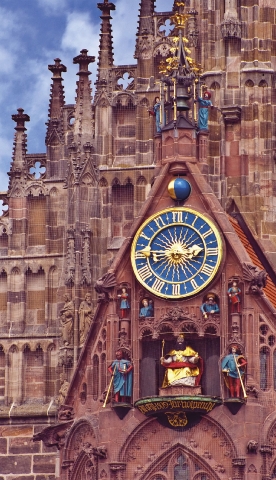
Clock face of the brick Gothic Frauenkirche, or Church of Our Lady, in Nuremberg
242-243_EW_Germany.indd 242 09/10/17 12:49 pm 242-243_EW_Germany.indd 243 09/10/17 12:49 pm

