


Page 387 - (DK Eyewitness) Travel Guide - Germany
P. 387
HESSE 385
a guest room or court- Nearby stands the late-Gothic,
room, and were from 15th-century Pfarrkirche St
the 14th century used Michael (parish church of St
as a chapel. Remains of Michael). Inside are some
the original wall paint- interesting epitaphs including
ings are still visible here. the double tombstone of
The façade is decorated Philipp I and Georg I, dating
with red and white from the late 15th century. A
stone mosaics inspired true rarity is the 18th-century
by Franco-Merovingian synagogue, which escaped
art. The vertical divides, being burned by the National
created by pilasters and Socialists in 1938.
entablature, are copies In the Steinbach district of
of ancient designs – an Michelstadt stands the
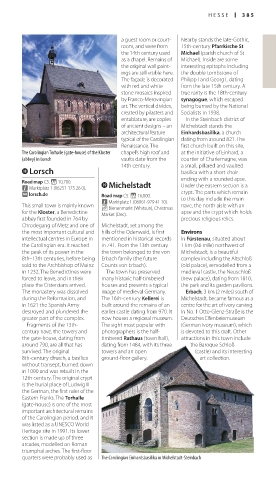
archi tectural feature Einhardsbasilika, a church
typical of the Carolingian dating from around 821. The
Renaissance. The first church built on this site,
The Carolingian Torhalle (gate-house) of the Kloster chapel’s high roof and at the initiative of Einhard, a
(abbey) in Lorsch vaults date from the courtier of Charlemagne, was
14th century. a small, pillared and vaulted
i Lorsch basilica with a short choir
ending with a rounded apse.
Road map C5. * 10,700. o Michelstadt
n Marktplatz 1 (06251-175 26 0). Under the eastern section is a
∑ lorsch.de Road map C5. * 16,000. crypt. The parts which remain
n Marktplatz 1 (06061-979 41 10). to this day include the main
This small town is mainly known _ Bienenmarkt (Whitsun), Christmas nave, the north aisle with an
for the Kloster, a Benedictine Market (Dec). apse and the crypt which holds
abbey first founded in 764 by precious religious relics.
Chrodegang of Metz and one of Michelstadt, set among the
the most important cultural and hills of the Odenwald, is first Environs
intellectual centres in Europe in mentioned in historical records In Fürstenau, situated about
the Carolingian era. It reached in 741. From the 13th century 1 km (0.6 mile) northwest of
the peak of its power in the the town belonged to the von Michelstadt, is a beautiful
8th–13th centuries, before being Erbach family (the future complex including the Altschloß
sold to the Archbishop of Mainz Counts von Erbach). (old palace), remodelled from a
in 1232. The Benedictines were The town has preserved medieval castle, the Neuschloß
forced to leave, and in their many historic half-timbered (new palace), dating from 1810,
place the Cistercians arrived. houses and presents a typical the park and its garden pavilions.
The monastery was dissolved image of medieval Germany. Erbach, 3 km (2 miles) south of
during the Reformation, and The 16th-century Kellerei is Michelstadt, became famous as a
in 1621 the Spanish Army built around the remains of an centre for the art of ivory carving.
destroyed and plundered the earlier castle dating from 970. It In No. 1 Otto-Glenz-Straße is the
greater part of the complex. now houses a regional museum. Deutsches Elfenbein museum
Fragments of the 13th- The sight most popular with (German ivory museum), which
century nave, the towers and photographers is the half- is devoted to this craft. Other
the gate-house, dating from timbered Rathaus (town hall), attractions in this town include
around 790, are all that has dating from 1484, with its three the Baroque Schloß
survived. The original towers and an open (castle) and its interesting
8th-century church, a basilica ground-floor gallery. art collection.
without transept, burned down
in 1090 and was rebuilt in the
12th cen tury. The original crypt
is the burial place of Ludwig II
the German, the first ruler of the
Eastern Franks. The Torhalle
(gate-house) is one of the most
important architectural remains
of the Carolingian period, and it
was listed as a UNESCO World
Heritage site in 1991. Its lower
section is made up of three
arcades, modelled on Roman
triumphal arches. The first-floor
quarters were probably used as The Carolingian Einhardsbasilika in Michelstadt-Steinbach
384-385_EW_Germany.indd 385 09/10/17 2:31 pm

