


Page 389 - (DK Eyewitness) Travel Guide - Germany
P. 389
WESTERN GERM AN Y 387
NORTH RHINE–
WESTPHALIA
Originally consisting of two distinct provinces with somewhat
diverging histories, the region of North Rhine-Westphalia today
has its own strong identity. It encompasses the vast valley of the
Ruhr river, rich in mineral deposits, where over the past 200 years
huge conurbations have developed, comprising dozens of industrial cities
that are gradually merging into one another.
As a province, the North Rhineland, situated thanks to great investment, its industrial
along the lower Rhine valley, goes back to cities have transformed themselves into
Roman times. In the Middle Ages most of attractive cultural centres.
this area was ruled by the Bishops of The history of towns such as Bonn,
Cologne (Köln). The North Rhineland cities Aachen, Cologne (Köln) and Xanten
grew and prospered thanks to their trade goes back to Roman times, and they
links, and in the 19th century they became have preserved much of their ancient
major centres of mining and heavy industry. heritage to this day. Evidence of
Westphalia forms the eastern part of the Romanesque art, which flourished
land. Once a Saxon territory, its history in the Rhineland, is today apparent in
was often intertwined with that of the numerous impressive abbeys dotted
Rhineland. Only its western end has been throughout the region and in the
heavily industrialized. churches of Cologne, which also boasts
North Rhine-Westphalia is not the largest the colossal Gothic Dom.
of the German regions, but with a popu- Much of North Rhine-Westphalia is
lation of nearly 18 million it is the most rural, and the region offers thousands of
heavily populated one. It is often thought kilometres of tracks for walking in the
that the region, and in particular the heavily Teutoburg Forest and in the Northern Eifel
industrialized Ruhr valley, has little to offer mountains, as well as splendid conditions
to its visitors, but this is a mistaken belief. for watersports and fishing in the
Its splendid past has left many priceless Sauerland. It also has surprisingly good ski
historic monuments and more recently, slopes, such as in the Rothaar Mountains.
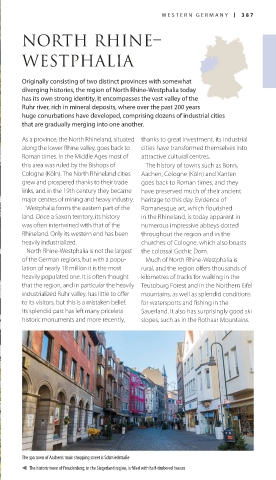
The spa town of Aachen’s main shopping street is Schmiedstraße
The historic town of Freudenberg, in the Siegerland region, is filled with half-timbered houses
386-387_EW_Germany.indd 387 09/10/17 12:50 pm

