


Page 410 - (DK Eyewitness) Travel Guide - Germany
P. 410
408 WESTERN GERM AN Y C OL OGNE (K ÖLN) 409
Wallraf-Richartz-Museum & Fondation Corboud Gallery Guide VISITORS’ CHECKLIST
Each floor in the museum displays
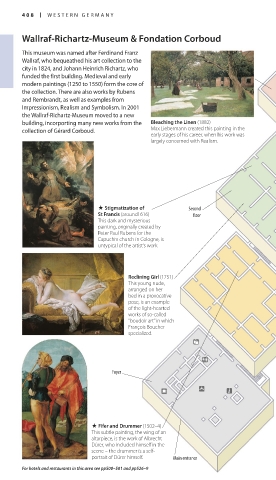
This museum was named after Ferdinand Franz paintings belonging to one era. Practical Information
Wallraf, who bequeathed his art collection to the On the first floor, the exhibition Wallraf-Richartz-Museum
& Fondation Corboud: Oben-
city in 1824, and Johann Heinrich Richartz, who begins with a collection of marspforten 40. Tel (0221) 22
funded the first building. Medieval and early art dating from the 12 11 19. Open 10am–6pm
Middle Ages; the
modern paintings (1250 to 1550) form the core of second floor holds Tue–Sun & hols (to 10pm 1st
the collection. There are also works by Rubens 17th–18th century art, & 3rd Sun of month). = &
∑ wallraf.museum
and Rembrandt, as well as examples from and on the third floor
Impressionism, Realism and Symbolism. In 2001 works of art from the
the Wallraf-Richartz-Museum moved to a new 19th century are
building, incorporting many new works from the Bleaching the Linen (1882) displayed, organized
by the schools of art
collection of Gérard Corboud. Max Liebermann created this painting in the
early stages of his career, when his work was they represent.
largely concerned with Realism.
Girls on a Bridge (1905)
Third floor Edvard Munch covered the
same subject several times
(see p441). The version held
in Cologne is one of the
earliest, and features an
urbanized landscape.
. Stigmatization of Second
St Francis (around1616) floor
This dark and mysterious
painting, originally created by
Peter Paul Rubens for the
Capuchin church in Cologne, is Jacob accuses Laban
untyp ical of the artist’s work. of giving him Lai instead
of Rachel as a wife (1628)
This biblical scene was
painted by one of the
most outstanding
Reclining Girl (1751) Dutch masters, Hendrick
This young nude, ter Brugghen.
arranged on her
bed in a provocative
pose, is an example First floor
of the light-hearted
works of so-called
“boudoir art” in which
François Boucher
specialized.
Old Woman and Boy
(around 1650–60)
This scene was painted by
Bartolome Esteban Murillo.
Foyer The artist excelled not only as
the master of charmingly
sentimental depictions of the
Madonna, but was also an
excellent observer of every-
day life in 17th-century Spain.
Key
. Fifer and Drummer (1502–4) Medieval paintings
This subtle painting, the wing of an Madonna and Child (1325–30) 17th- and 18th-century
altarpiece, is the work of Albrecht This central panel of a polyptych paintings
Dürer, who included himself in the by Simone Martini is thought to 19th- and 20th-century
scene – the drummer is a self- have originated from the San paintings
portrait of Dürer himself. Main entrance Agostino church in San Giminiano. Non-exhibition space
For hotels and restaurants in this area see pp500–501 and pp526–9
408-409_EW_Germany.indd 408 09/10/17 2:33 pm 408-409_EW_Germany.indd 409 09/10/17 2:33 pm

