


Page 473 - (DK Eyewitness) Travel Guide - Germany
P. 473
NOR THERN GERM AN Y 471
MECKLENBURG-
LOWER POMERANIA
The medieval towns of Schwerin, Wismar, Rostock and Stralsund,
as well as several magnificent architectural monuments, provide
reason enough to visit this part of Germany, yet it also offers a
largely untouched landscape of forests and lakes. Along the Baltic
coastline, tourists delight in the beautiful sandy beaches of Darß or Usedom,
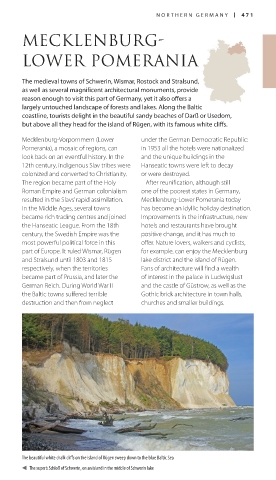
but above all they head for the island of Rügen, with its famous white cliffs.
Mecklenburg-Vorpommern (Lower under the German Democratic Republic:
Pomerania), a mosaic of regions, can in 1953 all the hotels were nationalized
look back on an eventful history. In the and the unique buildings in the
12th century, indigenous Slav tribes were Hanseatic towns were left to decay
colonized and converted to Christianity. or were destroyed.
The region became part of the Holy After reunification, although still
Roman Empire and German colonialism one of the poorest states in Germany,
resulted in the Slavs’ rapid assimilation. Mecklenburg-Lower Pomerania today
In the Middle Ages, several towns has become an idyllic holiday destination.
became rich trading centres and joined Improvements in the infrastructure, new
the Hanseatic League. From the 18th hotels and restaurants have brought
century, the Swedish Empire was the positive change, and it has much to
most powerful political force in this offer. Nature lovers, walkers and cyclists,
part of Europe. It ruled Wismar, Rügen for example, can enjoy the Mecklenburg
and Stralsund until 1803 and 1815 lake district and the island of Rügen.
respectively, when the territories Fans of architecture will find a wealth
became part of Prussia, and later the of interest in the palace in Ludwigslust
German Reich. During World War II and the castle of Güstrow, as well as the
the Baltic towns suffered terrible Gothic brick architecture in town halls,
destruction and then from neglect churches and smaller buildings.
The beautiful white chalk cliffs on the island of Rügen sweep down to the blue Baltic Sea
The superb Schloß of Schwerin, on an island in the middle of Schwerin lake
470-471_EW_Germany.indd 471 09/10/17 12:50 pm

