


Page 79 - (DK Eyewitness) Travel Guide - Germany
P. 79
EASTERN CENTRE 77
Liebknecht proclaimed the birth design by Johann Boumann.
of the Socialist Republic. Built between 1747 and 1750,
In 1989 the square reverted to the cathedral included the
its original name and a former original Hohenzollern family
GDR government building was crypt, one of the largest of its
torn down. A palacelike building, kind in Europe. The present
the HumboldtForum, will be an NeoBaroque structure is the
international and cultural centre work of Julius Raschdorff and
when complete in 2019. dates from 1894 to 1905.
Following severe World War II
damage, the cathedral has
r DDR Museum been restored in a simplified
form. The Hohenzollern
KarlLiebknecht Straße 1. Map 5 D1. memorial chapel, which
Tel (030) 847 123 731. &
Alexanderplatz. @ 100, 200, TXL. adjoined the northern walls,
Open 10am–8pm Mon–Sun (to has been dismantled.
10pm Sat).
The surviving Stadtschloß portal fronting This privately run museum was
a government building enlarged in 2016 and provides a
fascinating, interactive insight
e Schloßplatz into daily life in the former East
Germany. Visit a reconstructed
Map 5 D2. Hackescher Markt.
@ 100, 147, 200, TXL. flat and take a simulated ride in
an old Trabant car through a
This square was once the site concrete housing estate.
of a huge residential complex
known as Stadtschloß (City
Castle). Built in 1451, it served t Berliner Dom
as the main residence of the Am Lustgarten. Map 5 D1. Tel (030)
Brandenburg Electors. It was 202 69 136. Hackescher Markt.
transformed from a castle to a @ 100, 200, TXL Open Apr–Sep:
palace in the mid16th century 9am–8pm Mon–Sat, noon–8pm Sun;
when Elector Friedrich III (later Oct–Mar: 9am–7pm Mon–Sat, noon–
King Friedrich I) ordered its 7pm Sun. & 5 10am, 6pm Sun.
reconstruction in the Baroque
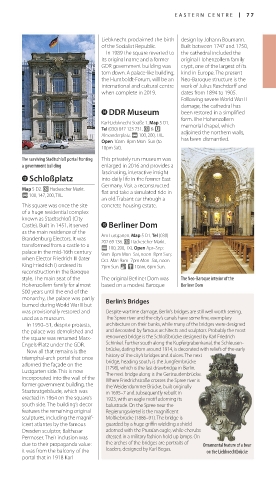
style. The main seat of the The original Berliner Dom was The Neo-Baroque interior of the
Hohenzollern family for almost based on a modest Baroque Berliner Dom
500 years until the end of the
monarchy, the palace was partly Berlin’s Bridges
burned during World War II but
was provisionally restored and Despite wartime damage, Berlin’s bridges are still well worth seeing.
used as a museum. The Spree river and the city’s canals have some fine, exemplary
In 1950–51, despite protests, architecture on their banks, while many of the bridges were designed
the palace was demolished and and decorated by famous architects and sculptors. Probably the most
the square was renamed Marx renowned bridge is the Schloßbrücke designed by Karl Friedrich
EngelsPlatz under the GDR. Schinkel. Further south along the Kupfergrabenkanal, the Schleusen
Now all that remains is the brücke, dating from around 1914, is decorated with reliefs of the early
triumphalarch portal that once history of the city’s bridges and sluices. The next
adorned the façade on the bridge, heading south, is the Jungfernbrücke
(1798), which is the last drawbridge in Berlin.
Lustgarten side. This is now The next bridge along is the Gertraudenbrücke.
incorporated into the wall of the Where Friedrichstraße crosses the Spree river is
former government building, the the Weidendammer Brücke, built originally
Staatsratgebäude, which was in 1695–7 and subsequently rebuilt in
erected in 1964 on the square’s 1923, with an eagle motif adorning its
south side. The building’s decor balustrade. On the Spree near the
features the remaining original Regierungsviertel is the magnificent
sculptures, including the magnif Moltkebrücke (1886–91). The bridge is
icent atlantes by the famous guarded by a huge griffin wielding a shield
Dresden sculptor, Balthasar adorned with the Prussian eagle, while cherubs
Permoser. Their inclusion was dressed in a military fashion hold up lamps. On
due to their propaganda value: the arches of the bridges are portraits of Ornamental feature of a bear
it was from the balcony of the leaders, designed by Karl Begas. on the Liebknechtbrücke
portal that in 1918 Karl
076-077_EW_Germany.indd 77 09/10/17 12:54 pm

