


Page 85 - (DK Eyewitness) Travel Guide - Germany
P. 85
EASTERN CENTRE 83
f Fernsehturm VISITORS’ CHECKLIST
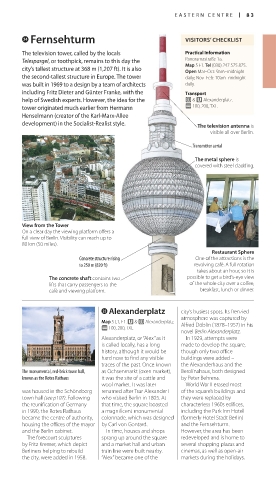
The television tower, called by the locals Practical Information
Telespargel, or toothpick, remains to this day the Panoramastraße 1a.
Map 5 E1. Tel (030) 247 575 875.
city’s tallest structure at 368 m (1,207 ft). It is also Open Mar–Oct: 9am–midnight
the second-tallest structure in Europe. The tower daily; Nov–Feb: 10am–midnight
was built in 1969 to a design by a team of architects daily.
including Fritz Dieter and Günter Franke, with the Transport
help of Swedish experts. However, the idea for the & Alexanderplatz.
tower originated much earlier from Hermann @ 100, 200, TXL.
Henselmann (creator of the Karl-Marx-Allee
development) in the Socialist-Realist style. The television antenna is
visible all over Berlin.
Transmitter aerial
The metal sphere is
covered with steel cladding.
View from the Tower
On a clear day the viewing platform offers a
full view of Berlin. Visibility can reach up to
80 km (50 miles).
Restaurant Sphere
Concrete structure rising One of the attractions is the
to 250 m (820 ft) revolving café. A full rotation
takes about an hour, so it is
The concrete shaft contains two possible to get a bird’s-eye view
lifts that carry passengers to the of the whole city over a coffee,
café and viewing platform. breakfast, lunch or dinner.
d Alexanderplatz city’s busiest spots. Its frenzied
atmosphere was captured by
Map 5 E1, F1. & Alexanderplatz.
@ 100, 200, TXL. Alfred Döblin (1878–1957) in his
novel Berlin Alexanderplatz.
Alexanderplatz, or “Alex” as it In 1929, attempts were
is called locally, has a long made to develop the square,
history, although it would be though only two office
hard now to find any visible buildings were added –
traces of the past. Once known the Alexanderhaus and the
The monumental, red-brick town hall, as Ochsenmarkt (oxen market), Berolinahaus, both designed
known as the Rotes Rathaus it was the site of a cattle and by Peter Behrens.
wool market. It was later World War II erased most
was housed in the Schöneberg renamed after Tsar Alexander I of the square’s buildings and
town hall (see p107). Following who visited Berlin in 1805. At they were replaced by
the reunification of Germany that time, the square boasted characterless 1960s edifices,
in 1990, the Rotes Rathaus a magnificent monumental including the Park Inn Hotel
became the centre of authority, colonnade, which was designed (formerly Hotel Stadt Berlin)
housing the offices of the mayor by Carl von Gontard. and the Fernsehturm.
and the Berlin cabinet. In time, houses and shops However, the area has been
The forecourt sculptures sprang up around the square redeveloped and is home to
by Fritz Kremer, which depict and a market hall and urban several shopping plazas and
Berliners helping to rebuild train line were built nearby. cinemas, as well as open-air
the city, were added in 1958. “Alex” became one of the markets during the holidays.
082-083_EW_Germany.indd 83 09/10/17 12:54 pm

