


Page 27 - The Hollywood Reporter (January 2020)
P. 27
Who else did you have in the audience for               would come in. If we were shooting at night
                                                                         the reading?                                            and throwing taxi cabs into the river, Emma
                                                                         We had Rick Yorn and we had various agents.             could worry about that. (Laughs.) That’s where
                                                                         We had a couple of people who could possibly            it’s wonderful to have good partners.
                                                                         finance the movie. [Producer] Irwin Winkler
                                                                         was there. But it was also really for Marty to          Did you have a favorite day on set or a favorite
                                                                         hear it again — for everyone to hear it again           moment from principal photography that sticks
                                                                         and decide we’re going to continue to put our           with you?
                                                                         efforts into this. And the most passionate one          There were so many, like seeing Bob and Joe
                                                                         was really Bob in pushing and continuing to             together for the first time. But what [sticks
                                                                         push this forward.                                      out] is actually the last day of filming, which
                                                                                                                                 was a reshoot of Bob in the scene at the very

                                                                         Have you or anyone on the team watched the              end of the movie. There were certain things
                                                                         recording since you did the reading?                    that Bob felt he needed to do. The end of a
                                                                         I have watched bits and pieces of it. Nobody            movie is always emotional — you’re saying
                                                                         else has seen it for a while, but you never know        goodbye to a lot of people that you’ve become
                                                                         where it will pop up. (Laughs.)                         family with, and you’re not going to see them
                 the first day of production, there was always                                                                    again in the same context. But this had a
                 [a thought that] this may not happen. But I             Do you think the movie benefited from having            particularly profound meaning for me. I tear
                 also think that part of what I have as a pro-           this length of development?                             up just thinking about it. On this movie, it’s
                 ducer is the tenacity to keep pushing a project         I don’t think the movie itself changed very             Martin Scorsese and Robert De Niro and all
                 forward and to never give up on it. And this            much. And the script didn’t change very                 these men that came together after having
                 was something [Bob] wanted to do, so he was             much. But what did change was everyone’s                made Mean Streets and Goodfellas and Casino,
                 constantly pushing this forward too. It was             perspective. Marty talks a lot about the                and this was the end of that genre for them.
                 an uphill battle until Netflix was born. The             perspective of time and place, and how they             I found myself looking at Marty’s work in the
                 fact is that Netflix didn’t exist [as a content          now look at things as men in their 70s,                 history of cinema, and what that particular
                 creator] back in 2007.                                  versus men in their 60s.                                style of cinema meant for their journeys. Just

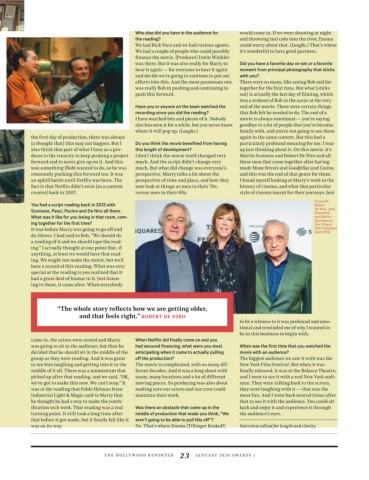
                                                                                                                                                                         From left:
                 You had a script reading back in 2013 with                                                                                                              Robert
                                                                                                                                                                         De Niro, Jane
                 Scorsese, Pesci, Pacino and De Niro all there.                                                                                                          Rosenthal
                 What was it like for you being in that room, com-                                                                                                       and Martin
                                                                                                                                                                         Scorsese at
                 ing together for the first time?                                                                                                                        the Tribeca
                 It was before Marty was going to go off and                                                                                                             Film Festival in
                                                                                                                                                                         April 2019.
                 do Silence. I had said to Bob, “We should do
                 a reading of it and we should tape the read-
                 ing.” I actually thought at one point that, if
                 anything, at least we would have that read-
                 ing. We might not make the movie, but we’d
                 have a record of this reading. What was very
                 special at the reading is you realized that it
                 had a great deal of humor in it. Just listen-
                 ing to them, it came alive. When everybody


                               “The whole story reflects how we are getting older,
                                           and that feels right.” ROBERT DE NIRO
                                                                                                                                 to be a witness to it was profound and emo-
                                                                                                                                 tional and reminded me of why I wanted to
                                                                                                                                 be in this business to begin with.
                 came in, the actors were seated and Marty               When Netflix did finally come on and you
                 was going to sit in the audience, but then he           had secured financing, what were you most               When was the first time that you watched the
                 decided that he should sit in the middle of the         anticipating when it came to actually pulling           movie with an audience?
                 group as they were reading. And it was great            off the production?                                     The biggest audience we saw it with was the
                 to see him laughing and getting into it in the          The movie is complicated, with so many dif-             New York Film Festival. But when it was
                 middle of it all. There was a momentum that             ferent decades. And it was a long shoot with            finally released, it was at the Belasco Theatre,
                 picked up after that reading, and we said, “OK,         many, many locations and a lot of different             and I went to see it with a real New York audi-

                 we’ve got to make this now. We can’t stop.” It          moving pieces. So producing was also about              ence. They were talking back to the screen,
                 was at the reading that Pablo Helman from               making sure our actors and our crew could               they were laughing with it — that was the
                 Industrial Light & Magic said to Marty that             maintain their work.                                    most fun. And I went back several times after
                 he thought he had a way to make the youth-                                                                      that to see it with the audience. You could sit
                 ification tech work. That reading was a real             Was there an obstacle that came up in the               back and enjoy it and experience it through
                 turning point. It still took a long time after          middle of production that made you think, “We           the audience’s eyes.
                 that before it got made, but it finally felt like it     aren’t going to be able to pull this off”?
                 was on its way.                                         No. That’s where Emma [Tillinger Koskoff]               Interview edited for length and clarity.


                                                        T H E   H O L L Y W O O D   R E P O R T E R  2 3  J A N U A R Y   2 0 2 0   A W A R D S   1

