


Page 24 - All About History - Issue 16-14
P. 24
Transport


                                                                TRAVELLING TO A NEW LIFE ON THE WAGON
                                                                   TRAIL, NORTH AMERICA, 19TH CENTURY


                                                                          n the 19th century the USA experienced a

                                                                          migration the likes of which it had not seen before,
                                                                          as many of its citizens moved west seeking a
                                                                          prosperous new life. The wagons carried their
                                                                        I hopes and dreams across the country. With the
           ANIMAL-DRIVEN                                                distances some made into the thousands of miles
                                                                        and with the wagons often carrying a family’s
                                                                        worldly possessions, it was vital that they could last
                                                                        the distance.
                                                                          The prairie schooner was the wagon of choice.
                  TRANSPORT                                             This was smaller and lighter than the Conestoga,
                                                                        which was used for hauling freight and therefore
                                                                        more suitable for long distances. One wagon was
                                                                        typically enough for a family of four although it
                                                                        would be very cramped and supplies would take up
                                                                        almost the entire space within the wag


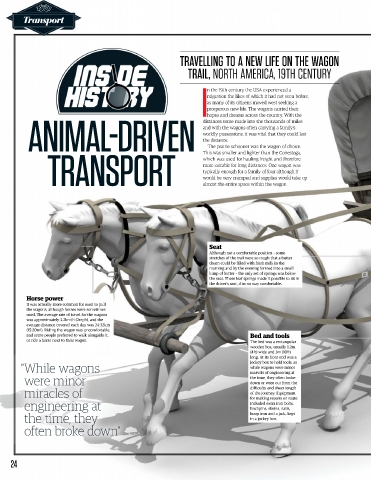
                                                                           Seat
                                                                           Although not a comfortable position – some
                                                                           stretches of the trail were so rough that a butter
                                                                           churn could be filled with fresh milk in the
                                                                           morning and by the evening formed into a small
                                                                           lump of butter – the only set of springs was below
                                                                           the seat. These leaf springs made it possible to sit in
                                                                           the driver’s seat, if in no way comfortable.

          Horse power
          It was actually more common for oxen to pull
          the wagons, although horses were sometimes
          used. The average rate of travel for the wagons
          was approximately 3.2km/h (2mph), and the
          average distance covered each day was 24-32km
          (15-20mi). Riding the wagon was uncomfortable,
          and some people preferred to walk alongside it,                                Bed and tools
          or ride a horse next to their wagon.                                           The bed was a rectangular
                                                                                         wooden box, usually 1.2m
                                                                                         (4ft) wide and 3m (10ft)
                                                                                         long. At its front end was a
                                                                                         jockey box to hold tools, as
        “ While wagons                                                                   while wagons were minor
                                                                                         marvels of engineering at
          were minor                                                                     the time, they often broke
                                                                                         down or wore out from the
                                                                                         difficulty and sheer length
          miracles of                                                                    of the journey. Equipment
                                                                                         for making repairs en route
          engineering at                                                                 included extra iron bolts,
                                                                                         linchpins, skeins, nails,
          the time, they                                                                 hoop iron and a jack, kept
                                                                                         in a jockey box.
          often broke down”


     24

