


Page 25 - All About History - Issue 16-14
P. 25
Transport


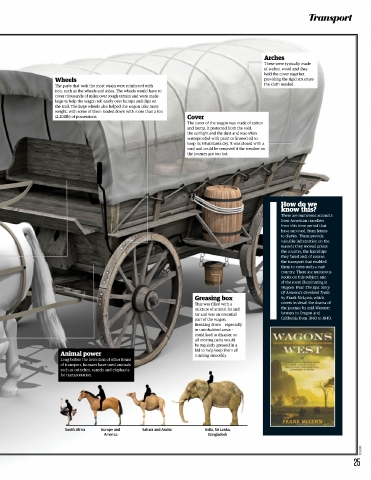
                                                                                              Arches
                                                                                              These were typically made
                                                                                              of walnut wood and they
                                                                                              held the cover together,
                    Wheels                                                                    providing the rigid structure
                                                                                              the cloth needed.
                    The parts that took the most strain were reinforced with
                    iron, such as the wheels and axles. The wheels would have to
                    cover thousands of miles over rough terrain and were made
                    large to help the wagon roll easily over bumps and dips on
                    the trail. The large wheels also helped the wagon take more
                    weight, with some of them loaded down with more than a ton
                    (2,200lb) of possessions.                      Cover
                                                                   The cover of the wagon was made of cotton
                                                                   and hemp. It protected from the cold,
                                                                   the sunlight and the dust and was often
                                                                   waterproofed with paint or linseed oil to
                                                                   keep its inhabitants dry. It was closed with a
                                                                   cord and could be removed if the weather on
                                                                   the journey got too hot.


                                                                                                    How do we
                                                                                                    know this?
                                                                                                    There are numerous accounts
                                                                                                    from American travellers
                                                                                                    from this time period that
                                                                                                    have survived, from letters
                                                                                                    to diaries. These provide
                                                                                                    valuable information on the
                                                                                                    reasons they moved across
                                                                                                    the country, the hardships
                                                                                                    they faced and, of course,
                                                                                                    the transport that enabled
                                                                                                    them to cross such a vast
                                                                                                    country. There are numerous
                                                                                                    books on this subject; one
                                                                                                    of the most illuminating is
                                                                                                    Wagons West: The Epic Story
                                                                                                    Of America’s Overland Trails
                                                                      Greasing box                  by Frank McLynn, which
                                                                      This was filled with a        covers in detail the drama of
                                                                      mixture of animal fat and     the journey by mid-Western
                                                                      tar and was an essential      farmers to Oregon and
                                                                      part of the wagon.            California from 1840 to 1849.
                                                                      Breaking down – especially
                                                                      in uninhabited areas –
                                                                      could lead to disaster, so
                                                                      all moving parts would
                                                                      be regularly greased in a
                                                                      bid to help keep them all
                      Animal power                                    running smoothly.
                      Long before the invention of other forms
                      of transport, humans have used animals
                      such as ostriches, camels and elephants
                      for transportation.


                        South Africa  Europe and   Sahara and Arabia     India, Sri Lanka,
                                      America                             Bangladesh

                                                                                                                                © Sol 90
                                                                                                                             25

