


Page 44 - All About History - Issue 16-14
P. 44
What was it like?


        BOSTON, 1919


                               The US city was badly hit by an

                  USA
                               economic recession after WWI, as
                        Boston O
                               strikes and political clashes threatened

                               to tear the city apart at its seams…

        © Alamy; Getty Images; Boston Public Library (BPL); Edward N. Jackson (US Army Signal Corps)  Ttheirs. Faced with poor wages and unacceptable   responded by recruiting militia pulled from Harvard
                                                      On 9 September, the police force went on strike.
                 he year following the Great War found the
                                                     Curtis and Massachusetts Governor Calvin Coolidge
                 United States in the grips of an economic
                 downturn, as returning soldiers came home
                 to find the jobs they’d left behind no longer
                                                     University’s athletes and volunteers. Rioting broke
                                                     out that evening and as violence increased, Coolidge
             working conditions, blue-collar Boston began to take
                                                     delivered 5,000 State Guards to combat the unrest.
                                                     Their lack of experience with crowd control showed
             action. From telephone operators to train workers, the
             city’s labour force was getting organised.
                                                     as they opened fire, killing two and wounding others.
                                                     As the violence continued, the media supported
               The concept of unions was seen by many as the
                                                     Coolidge’s efforts to suppress the insidious socialist
             first step in a terrifying slip toward communism.
                                                     menace, and a new police force was recruited. The
             Things came to a head in Boston in 1919 when the
             police force realised their grievances were simply
                                                     workers were torn between poor conditions and a
                                                     government desperate to suppress dissent. Boston,
             not being listened to. They began preparations for
             unionising and Police Commissioner Edwin Curtis
                                                     ideologies and political beliefs could tear it apart.
             suspended the leaders.
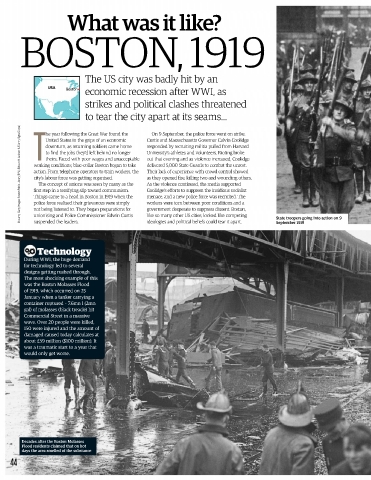
                                                                                                  September 1919
              Technology                             like so many other US cities, looked like competing   State troopers going into action on 9
          During WWI, the huge demand
          for technology led to several
          designs getting rushed through.
          The most shocking example of this
          was the Boston Molasses Flood
          of 1919, which occurred on 25
          January when a tanker carrying a
          container ruptured – 7.6mn l (2mn
          gal) of molasses (black treacle) hit
          Commercial Street in a massive
          wave. Over 20 people were killed,
          150 were injured and the amount of
          damaged caused today calculates at
          about £59 million ($100 million). It
          was a traumatic start to a year that
          would only get worse.


         Decades after the Boston Molasses
         Flood residents claimed that on hot
         days the area smelled of the substance
     44

