


Page 45 - All About History - Issue 16-14
P. 45
What was it like?
                                                                                                                BOSTON, 1919


                            Police
                      The grievances of the Boston police
                      force that led to the strike had been
                      filed long before there was talk of
                      unionising, and they were similar to
                      the complaints of workers all over
                      the country. There hadn’t been any
                      pay rises in 60 years, officers had
                      one day off every two weeks (with
                      73 to 98-hour work weeks), and the
                      police stations were in grotesque
                                                                                                            Changes in Europe had
                      condition. When the Protestant                                                        an effect on life in Boston
                      city heads began telling
                      the largely Irish-Catholic
                      workforce they couldn’t have                                       Finance
                      their demands, the conflict                                  With the war in Europe over, the US no longer produced
                      quickly escalated.                                           huge quantities of war-effort machines and goods, so jobs
                                                                                   began to dry up. Boston’s industrial base had begun to fall
                                                                                   apart as the initial boom in factories like the Porter Motor
                                      Government                                   Company declined at the start of the century as they moved
                                                                                   away, looking for cheaper labour. Farm prices fell, factories
                                Boston’s governor would take his iron will to the White House   were producing nothing, and the US fell into recession.
                                when he was elected President in 1923. Coolidge had run
                                unopposed for the Republican nomination for the governorship
                                                                                  Recession and debts plagued most
                                of Massachusetts in 1918 but only just beat his Democrat   ordinary people at this time
                                opponent. His hard line on the police strikes made an impression
                                around the country and played a key role in his policial success.


                                                Media
                                           wspapers sided with their government against
                                           e perceived communist menace. Terms like
                                           olshevism’ and ‘Red Unionite’ were thrown
                                           ound, while the idea that the police could give
                                            their duties was unthinkable. The five major
                                           ston newspapers sided with Coolidge, backing
                                           e governor against the threat of Bolshevism.
                                           ommunist newspaper The Revolutionary Age
                                            oved from Boston to New York before the strike


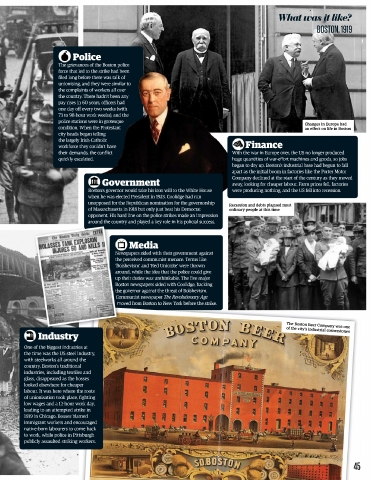
                                                                                                      The Boston Beer Company was one
                Industry                                                                              of the city’s industrial cornerstones

          One of the biggest industries at
          the time was the US steel industry,
          with steelworks all around the
          country. Boston’s traditional
          industries, including textiles and
          glass, disappeared as the bosses
          looked elsewhere for cheaper
          labour. It was here where the roots
          of unionisation took place, fighting
          low wages and a 12-hour work day,
          leading to an attempted strike in
          1919 in Chicago. Bosses blamed
          immigrant workers and encouraged
          native-born labourers to come back
          to work, while police in Pittsburgh
          publicly assaulted striking workers.


                                                                                                                             45

