


Page 18 - Forbes - Asia (December 2019 - January 2020)
P. 18
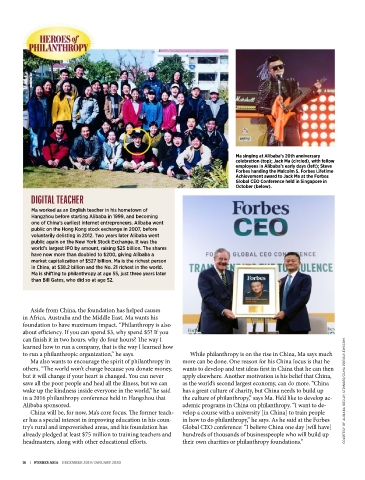
Ma singing at Alibaba’s 20th anniversary
                                                                                                      celebration (top); Jack Ma (circled), with fellow
                                                                                                      employees in Alibaba’s early days (left); Steve
                                                                                                      Forbes handing the Malcolm S. Forbes Lifetime
                                                                                                      Achievement award to Jack Ma at the Forbes
                                                                                                      Global CEO Conference held in Singapore in
                                                                                                      October (below).
               DIGITAL TEACHER


               Ma worked as an English teacher in his hometown of
               Hangzhou before starting Alibaba in 1999, and becoming
               one of China’s earliest internet entrepreneurs. Alibaba went
               public on the Hong Kong stock exchange in 2007, before
               voluntarily delisting in 2012. Two years later Alibaba went
               public again on the New York Stock Exchange. It was the
               world’s largest IPO by amount, raising $25 billion. The shares
               have now more than doubled to $200, giving Alibaba a
               market capitalization of $527 billion. Ma is the richest person
               in China, at $38.2 billion and the No. 21 richest in the world.
               Ma is shifting to philanthropy at age 55, just three years later
               than Bill Gates, who did so at age 52.


              Aside from China, the foundation has helped causes
           in Africa, Australia and the Middle East. Ma wants his
           foundation to have maximum impact. “Philanthropy is also
           about efficiency. If you can spend $3, why spend $5? If you
           can finish it in two hours, why do four hours? The way I
           learned how to run a company, that is the way I learned how
           to run a philanthropic organization,” he says.                          While philanthropy is on the rise in China, Ma says much
              Ma also wants to encourage the spirit of philanthropy in         more can be done. One reason for his China focus is that he
           others. “The world won’t change because you donate money,           wants to develop and test ideas first in China that he can then
           but it will change if your heart is changed. You can never          apply elsewhere. Another motivation is his belief that China,
           save all the poor people and heal all the illness, but we can       as the world’s second largest economy, can do more. “China
           wake up the kindness inside everyone in the world,” he said         has a great culture of charity, but China needs to build up           COURTESY OF ALIBABA GROUP; STRINGER/ZUMA PRESS/NEWSCOM
           in a 2016 philanthropy conference held in Hangzhou that             the culture of philanthropy,” says Ma. He’d like to develop ac-
           Alibaba sponsored.                                                  ademic programs in China on philanthropy. “I want to de-
              China will be, for now, Ma’s core focus. The former teach-       velop a course with a university [in China] to train people
           er has a special interest in improving education in his coun-       in how to do philanthropy,” he says. As he said at the Forbes
           try’s rural and impoverished areas, and his foundation has          Global CEO conference: “I believe China one day [will have]
           already pledged at least $75 million to training teachers and       hundreds of thousands of businesspeople who will build up
           headmasters, along with other educational efforts.                  their own charities or philanthropy foundations.”


           16     |     FORBES ASIA     DECEMBER 2019 / JANUARY 2020

