


Page 14 - Forbes - Asia (December 2019 - January 2020)
P. 14
ECONOMICS MATTERS                                                                                      YUWA HEDRICK-WONG


           Recession by Stealth


                                                   enerals are always           The first is the West’s declining economic dominance relative
                                                   fighting the last war.       to the rest of the world, and China in particular. The second
                                                   It’s not that different      is the rise of populism in Western democracies, arguably the
                                       Gwhen it comes to                        most serious challenge to the legitimacy of the liberal global
                                        fighting economic downturns.            order. And yet, even as the liberal global economic order
                                        Since the global financial crisis a     fades away, it’s unclear what a post-liberal global economic
                                        decade ago, we have been scour-         order will look like. So for now, the global economy is like
                                        ing the horizon for any signs of        a barfly at closing time: it has no clue where it’s going, but it
                                        financial fragility, such as asset      can’t stay here.
                                        bubbles, that could plunge us into         Developed world economies have meanwhile been se-
           the next global recession. Despite mounting evidence of a            riously weakened by prolonged zero interest rates, making
           weakening economy, there are no asset bubbles comparable             them vulnerable to unexpected shocks. Extraordinarily low
           to that of the pre-2008 period. And we won’t find any, even          interest rates distort the price of money, arguably the single
           as we edge closer to the next recession. Since the last global       most important price signal in a market economy. They
           financial crisis, the global economy has been reshaped by            poison the business environment, allowing poorly run busi-
           different forces, and the coming recession will be caused by         nesses to survive, jamming the gears of creative destruction
           factors totally different from those of the last one.                that drive any economic renewal. The survival of poorly run
              First off, the global economy today is mired in uncertain-        businesses also suck profits from more successful businesses,
           ty arising from the trade war, an enfeebled Europe, Brexit           sapping their ability to expand.
           and rising geopolitical tensions. An even deeper source of              Against this backdrop, any number of missteps could trig-
           uncertainty is that the liberal global economic order, in place      ger chain reactions that push developed world economies
           since the 1950s, is dying. Two trends are converging to kill it.     into recession. But we should also be prepared for a poten-
                                                                                                tially different kind of downturn. The accept-
                                                                                                ed definition of a recession is two consecu-
                                                                                                tive quarters of contraction in an economy.
                                                                                                The next recession, however, may not tech-
                                                                                                nically qualify as one. For example, we could
                                                                                                have one quarter of 0.3% growth, followed by
                                                                                                a contraction of 1.2% the next, then anemic
                                                                                                growth in the third and fourth quarter of, say,
                                                                                                0.1% each, and then another contraction of
                                                                                                0.5% and so on. While the technical definition
                                                                                                of a recession may never be met, the economy
                                                                                                would still be shrinking, left to wane inexora-
                                                                                                bly by impotent monetary and fiscal policies.
                                                                                                It would be a recession by stealth.  F


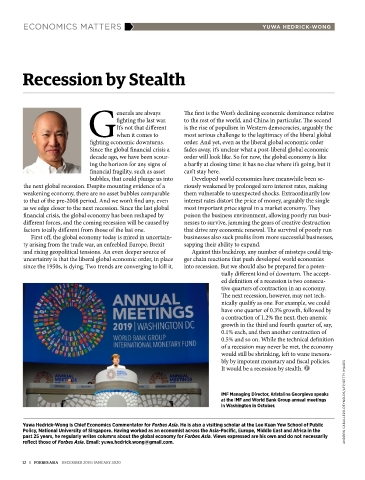
                                                                                                IMF Managing Director, Kristalina Georgieva speaks
                                                                                                at the IMF and World Bank Group annual meetings      ANDREW CABALLERO-REYNOLDS/AFP/GETTY IMAGES
                                                                                                in Washington in October.


           Yuwa Hedrick-Wong is Chief Economics Commentator for Forbes Asia. He is also a visiting scholar at the Lee Kuan Yew School of Public
           Policy, National University of Singapore. Having worked as an economist across the Asia-Pacific, Europe, Middle East and Africa in the
           past 25 years, he regularly writes columns about the global economy for Forbes Asia. Views expressed are his own and do not necessarily
           reflect those of Forbes Asia. Email: yuwa.hedrick.wong@gmail.com.


           12     |     FORBES ASIA     DECEMBER 2019 / JANUARY 2020

