


Page 90 - Forbes - Asia (December 2019 - January 2020)
P. 90
ENTREPRENEURS


           Wind turbines looked to


           Anschutz like any other natural

           resource business—kind of


           like an upside-down oil well,

           sucking energy out of the air.


           the well, which ignited into a raging inferno. Famous oil well
           firefighter Red Adair requested $100,000 to battle the blaze,
           and quick-thinking Anschutz saved his company by getting
           Universal Pictures to pay that sum for the filming rights. (The
           footage was used in the John Wayne flick Hellfighters.)
              Anschutz made his first mega-fortune in 1982, selling half
           of an oilfield on the Wyoming-Utah border to Mobil Oil for
           $500 million ($1.4 billion in today’s money). He reinvested
           in mining and railroads and built the Southern Pacific line,
           which in 1996 he sold to Union Pacific for $5.4 billion, valu-
           ing his shares in the new company at more than $900 million.
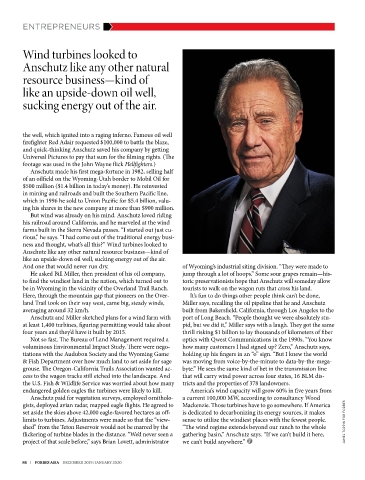
              But wind was already on his mind. Anschutz loved riding
           his railroad around California, and he marveled at the wind
           farms built in the Sierra Nevada passes. “I started out just cu-
           rious,” he says. “I had come out of the traditional energy busi-
           ness and thought, what’s all this?” Wind turbines looked to
           Anschutz like any other natural resource business—kind of
           like an upside-down oil well, sucking energy out of the air.
           And one that would never run dry.                                   of Wyoming’s industrial siting division. “They were made to
              He asked Bill Miller, then president of his oil company,         jump through a lot of hoops.” Some sour grapes remain—his-
           to find the windiest land in the nation, which turned out to        toric preservationists hope that Anschutz will someday allow
           be in Wyoming in the vicinity of the Overland Trail Ranch.          tourists to walk on the wagon ruts that cross his land.
           Here, through the mountain gap that pioneers on the Over-               It’s fun to do things other people think can’t be done,
           land Trail took on their way west, came big, steady winds,          Miller says, recalling the oil pipeline that he and Anschutz
           averaging around 32 km/h.                                           built from Bakersfield, California, through Los Angeles to the
              Anschutz and Miller sketched plans for a wind farm with          port of Long Beach. “People thought we were absolutely stu-
           at least 1,400 turbines, figuring permitting would take about       pid, but we did it,” Miller says with a laugh. They got the same
           four years and they’d have it built by 2015.                        thrill risking $1 billion to lay thousands of kilometers of fiber
              Not so fast. The Bureau of Land Management required a            optics with Qwest Communications in the 1990s. “You know
           voluminous Environmental Impact Study. There were nego-             how many customers I had signed up? Zero,” Anschutz says,
           tiations with the Audubon Society and the Wyoming Game              holding up his fingers in an “o” sign. “But I knew the world
           & Fish Department over how much land to set aside for sage          was moving from voice-by-the-minute to data-by-the-mega-
           grouse. The Oregon-California Trails Association wanted ac-         byte.” He sees the same kind of bet in the transmission line
           cess to the wagon tracks still etched into the landscape. And       that will carry wind power across four states, 16 BLM dis-
           the U.S. Fish & Wildlife Service was worried about how many         tricts and the properties of 378 landowners.
           endangered golden eagles the turbines were likely to kill.              America’s wind capacity will grow 60% in five years from
              Anschutz paid for vegetation surveys, employed ornitholo-        a current 100,000 MW, according to consultancy Wood
           gists, deployed avian radar, mapped eagle flights. He agreed to     Mackenzie. Those turbines have to go somewhere. If America
           set aside the skies above 42,000 eagle-favored hectares as off-     is dedicated to decarbonizing its energy sources, it makes
           limits to turbines. Adjustments were made so that the “view-        sense to utilize the windiest places with the fewest people.          JAMEL TOPPIN FOR FORBES
           shed” from the Teton Reservoir would not be marred by the           “The wind regime extends beyond our ranch to the whole
           flickering of turbine blades in the distance. “We’d never seen a    gathering basin,” Anschutz says. “If we can’t build it here,
           project of that scale before,” says Brian Lovett, administrator     we can’t build anywhere.” F


           86     |     FORBES ASIA     DECEMBER 2019 / JANUARY 2020

