


Page 98 - Forbes - Asia (December 2019 - January 2020)
P. 98
Recipe for
                             •   A
                                  S
                                    I
                                     A

                                                 Resilience
                                      •
            •

            A
             L U M N I   •
                                                 PichaEats is helping refugees in Malaysia put food

                                                 on their tables by putting food on yours.


                                                 BY PAMELA AMBLER


                  corching oil glistens in a wok in Naeem’s home kitchen
                  on the outskirts of Kuala Lumpur. Dressed in hijab,
                  she chops at a pile of onions, parsley and garlic to mix
          Sinto falafel balls as her 2-year-old tugs at her apron,
           squalling for attention. She has just filled an order of more
           than a dozen chicken gulai she started preparing at dawn.
              Naeem earns roughly 2,000 ringgit ($480) a month sell-
           ing food to PichaEats, a Malaysian social enterprise, while
           awaiting resettlement after fleeing with her family of four
           to Malaysia from Syria six years ago. PichaEats aims to pro-
           vide work to some of the 177,800 refugees and asylum-seek-
           ers like Naeem (a pseudonym—her real name has been with-
           held at the company’s request) registered in Malaysia by the
           UN refugee agency, the UNHCR. PichaEats will soon deliver
           Naeem’s food to diners around Kuala Lumpur.
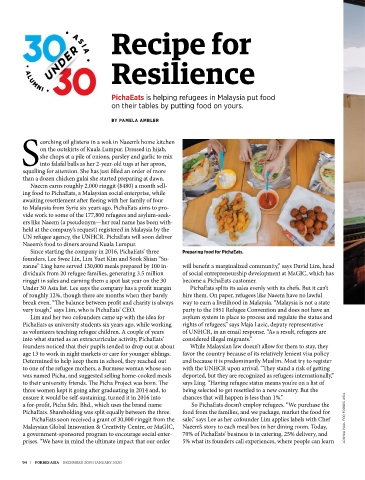
              Since starting the company in 2016, PichaEats’ three             Preparing food for PichaEats.
           founders, Lee Swee Lin, Lim Yuet Kim and Sook Shian “Su-
           zanne” Ling have served 130,000 meals prepared by 100 in-           will benefit a marginalized community,” says David Lim, head
           dividuals from 20 refugee families, generating 3.5 million          of social entrepreneurship development at MaGIC, which has
           ringgit in sales and earning them a spot last year on the 30        become a PichaEats customer.
           Under 30 Asia list. Lee says the company has a profit margin            PichaEats splits its sales evenly with its chefs. But it can’t
           of roughly 12%, though there are months when they barely            hire them. On paper, refugees like Naeem have no lawful
           break even. “The balance between profit and charity is always       way to earn a livelihood in Malaysia. “Malaysia is not a state
           very tough,” says Lim, who is PichaEats’ CEO.                       party to the 1951 Refugee Convention and does not have an
              Lim and her two cofounders came up with the idea for             asylum system in place to process and regulate the status and
           PichaEats as university students six years ago, while working       rights of refugees,” says Maja Lazic, deputy representative
           as volunteers teaching refugee children. A couple of years          of UNHCR, in an email response. “As a result, refugees are
           into what started as an extracurricular activity, PichaEats’        considered illegal migrants.”
           founders noticed that their pupils tended to drop out at about          While Malaysian law doesn’t allow for them to stay, they
           age 13 to work in night markets or care for younger siblings.       favor the country because of its relatively lenient visa policy
           Determined to help keep them in school, they reached out            and because it is predominantly Muslim. Most try to register
           to one of the refugee mothers, a Burmese woman whose son            with the UNHCR upon arrival. “They stand a risk of getting
           was named Picha, and suggested selling home-cooked meals            deported, but they are recognized as refugees internationally,”
           to their university friends. The Picha Project was born. The        says Ling. “Having refugee status means you’re on a list of
           three women kept it going after graduating in 2014 and, to          being selected to get resettled to a new country. But the
           ensure it would be self-sustaining, turned it in 2016 into          chances that will happen is less than 1%.”
           a for-profit, Picha Sdn. Bhd., which uses the brand name                 So PichaEats doesn’t employ refugees. “We purchase the
           PichaEats. Shareholding was split equally between the three.        food from the families, and we package, market the food for
               PichaEats soon received a grant of 30,000 ringgit from the      sale,” says Lee as her cofounder Lim applies labels with Chef         JOSHUA PAUL FOR FORBES ASIA
           Malaysian Global Innovation & Creativity Centre, or MaGIC,          Naeem’s story to each meal box in her dining room. Today,
           a government-sponsored program to encourage social enter-           70% of PichaEats’ business is in catering, 25% delivery, and
           prises. “We have in mind the ultimate impact that our order         5% what its founders call experiences, where people can learn


           94     |     FORBES ASIA     DECEMBER 2019 / JANUARY 2020

