


Page 100 - Forbes - Asia (December 2019 - January 2020)
P. 100
STRATEGIES


                                                  O                            rlando Bravo discovered his edge early. In 1985, at


                                                                               age 15, he traveled from his home in Mayagüez,
                                                                               Puerto Rico, a small town on the island’s western
                                                                               coast, to Bradenton, Florida, to enroll in the legend-
                                                                               ary tennis guru Nick Bollettieri’s grueling academy.
                                                                                  Bravo would wake at dawn, head to class at St.
                                                                               Stephen’s Episcopal School, then return to Bollett-
                                                                               ieri’s tennis courts at noon. He spent hours warring
                                                               against peers like Andre Agassi and Jim Courier under the broiling
                                                               sun. At sundown, after an hour to shower and eat, he would study,
                                                               then retire to a sweaty, two-bedroom condominium in which play-
                                                               ers bunked four to a room like army barracks. Then he would do it
                                                               all over again, six days a week, for a full year. “It was the tennis ver-
                                                               sion of Lord of the Flies,” says his former roommate Courier.
                                                                  The brutally competitive environment helped Bravo climb to
                                                               a top-40 ranking in the U.S. as a junior. Then he peaked. “It was
                                                               quite humbling,” recalls Bravo, who’s still fit from his weekly tennis
                                                               games. “It was a different level of hard work altogether. It became
                                                               clear I could operate at these super-high levels of pain.”
                                                                  That grit and perseverance eventually propelled him to the top
                                                               echelons of the private equity world. Few outside of finance have
                                                               heard of the 49-year-old Bravo, but he is the driving force behind
                                                               Wall Street’s hottest firm, the $39 billion (assets) Thoma Bravo.
                                                                  In February, the French business school HEC Paris, in conjunc-
                                                               tion with Dow Jones, named Thoma Bravo the best-performing
                                                               buyout investor in the world after studying 898 funds raised be-
                                                               tween 2005 and 2014. According to public data analyzed by Forbes,
                                                               its funds returned 30% net annually, far better than famous buy-


           WALL STREET’S


           BEST DEALMAKER


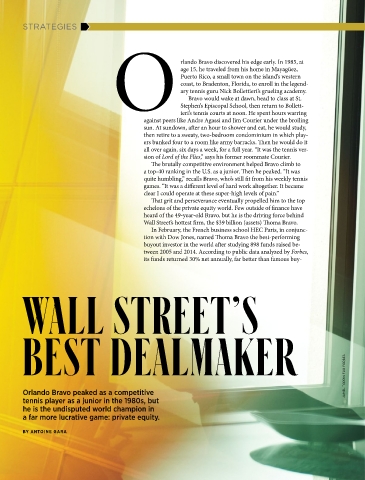
           Orlando Bravo peaked as a competitive                                                                                                     JAMEL TOPPIN FOR FORBES

           tennis player as a junior in the 1980s, but
           he is the undisputed world champion in
           a far more lucrative game: private equity.


           BY ANTOINE GARA

