


Page 106 - Homes & Antiques (February 2020)
P. 106
Focus on


          CONFIT


          POTS


          Nowadays they are

          used as vases or utensil

          holders, but con!t pots

          were originally made

          for much more practical

          reasons. Rosanna

          Morris explores their


          intriguing history


          The mustard-yellow vessel holding
          the bright sun!owers in Vincent van
          Gogh’s famous still life may not take
          centre stage, but it’s evidence that even
          in the late 19th century, con"t pots
          were used for decorative purposes.
          These days, antique versions from
          France, Spain and Italy are highly
          sought a#er for their simple, visual
          appeal, as well as their history.
             Van Gogh was living in southern
          France, an area associated with
          proli"c production of con"t pots, when
          he painted the second series of
          Sun!owers in 1888. Although
          commonly associated with France, the
          terraco$a pots were also widely used
           across southern Europe and beyond.
             ‘These pots were used for preserving
           food in the 19th century; mainly meats
           in fat, such as duck con"t,’ says dealer
           Caryl Tincknell of Violet Grey, who
           specialises in French antiques. ‘The
           word ‘con"t’ comes from the French
           verb ‘con"re’ which means to preserve.
           The jars were either stored in a cold
           larder or buried in the ground up to the
           glaze line.’
             In the days before refrigeration,
           foods were cooked in the summer
           months when produce was abundant
           and then packed into the pots and
           sealed with a thick layer of fat to
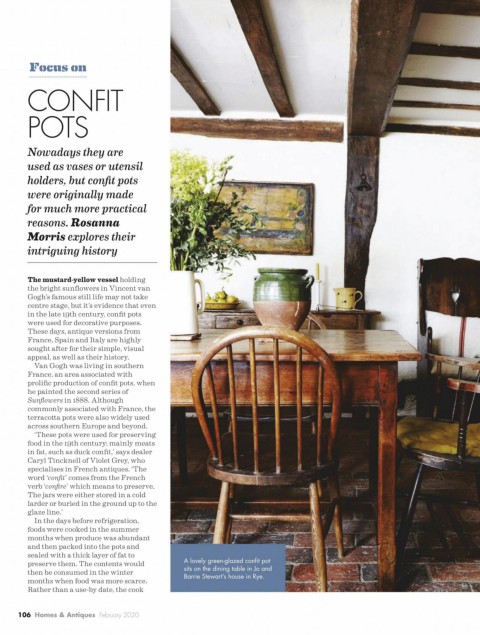
                                                                 A lovely green-glazed confit pot
           preserve them. The contents would
                                                                 sits on the dining table in Jo and
           then be consumed in the winter
                                                                 Barrie Stewart’s house in Rye.
           months when food was more scarce.
           Rather than a use-by date, the cook


       106  Homes & Antiques  February 2020

