


Page 107 - Homes & Antiques (February 2020)
P. 107
HOMES Tudor House
AT A GLANCE
What to look for when
investing in a con!t pot
Price varies according to the
condition and size of the pot,
as well as its age. Expect to pay
around £80 for an average size,
yellow-glazed pot, and around
£250 for a larger French confit pot.
Green confit pots are more
expensive again as these
are rarer than their yellow
counterparts, so too are
the very small versions,
according to Caryl.
Creamy-white pots
tend to be Italian and
these would have been used
for storing anchovies, olives
and sardines in brine or olive
would label each pot with the date it oil. Blue confit pots also exist, as
had been !lled and would know if the do patterned examples.
food was !t to eat.
Dealer Appley Hoare also specialises
in French antiques and o"en stocks
con!t pots. ‘Terraco#a is perfect for
this type of food preservation as it
absorbs moisture and keeps the
contents cool,’ she says. ‘That’s why
most of these pots are found in hot
climates.’ Once ubiquitous, these days
they are harder to come by, she admits.
‘Like all the most interesting 18th and
19th-century items, they are becoming
more di$cult to !nd.’
The pots were always glazed on the
inside and outside, although many are
only half glazed on the exterior to
allow for easier absorption of water.
The glazes range from a lovely creamy
shade, found in Italy, to a more yellow
and ochre !nish common to France
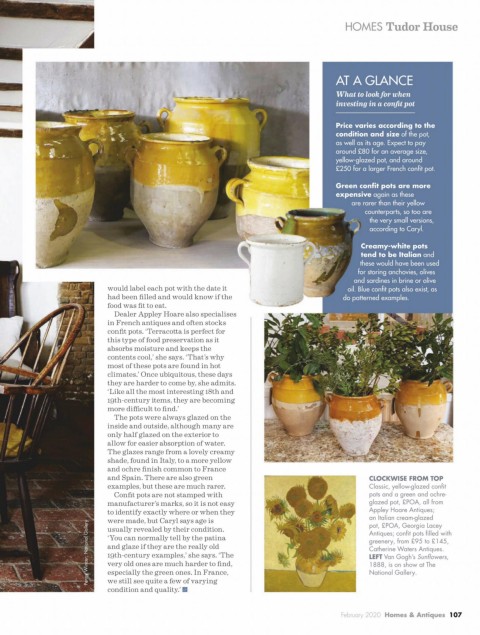
and Spain. There are also green CLOCKWISE FROM TOP
examples, but these are much rarer. Classic, yellow-glazed confit
Con!t pots are not stamped with pots and a green and ochre-
manufacturer’s marks, so it is not easy glazed pot, £POA, all from
Appley Hoare Antiques;
to identify exactly where or when they
an Italian cream-glazed
were made, but Caryl says age is
Penny Wincer; National Gallery ‘You can normally tell by the patina greenery, from £95 to £145,
pot, £POA, Georgia Lacey
usually revealed by their condition.
Antiques; confit pots filled with
and glaze if they are the really old
Catherine Waters Antiques.
19th-century examples,’ she says. ‘The
LEFT Van Gogh’s Sunflowers,
very old ones are much harder to !nd,
1888, is on show at The
especially the green ones. In France,
we still see quite a few of varying
condition and quality.’ National Gallery.
February 2020 Homes & Antiques 107

