


Page 66 - Homes & Antiques (February 2020)
P. 66
Focus on


          GILTWOOD


          OVERMANTEL MIRRORS


          Janet Gleeson explores how overmantels rose to

          prominence, becoming a staple of decorative schemes


          A giltwood overmantel mirror brings                  As technology progressed in the 18th
          an instant injection of elegance, light           century, ever larger overmantels were
          and opulence to a room. Plus, their               produced. To begin with, the French
          large scale makes them eye-catching               were pre-eminent, their mirrors
          focal points. ‘They’ve been status                adorning the homes of the rich in
          symbols for centuries, and they still             Europe. ‘Fireplaces in France were
          work in modern homes,’ says Laura                 o#en lower than those in Britain to
          Dadswell of Westland, London.                     accommodate them,’ says Laura.
             Mirror-making for the international               The architectural trends of the time
          market began in Venice in the 1500s,              shaped mirror styles and they were
          but the Venetian manufacturing                    o#en conceived as part of a decorative
          process – involving blowing cylinders             scheme. Spurred on by high taxes on
          of glass, then cu!ing the ends and                imported glass, British makers fought
          "a!ening the cylinder – limited the               back from the mid 18th century.
           size of glass plates they could produce.         Thomas Chippendale and his
           A sea change came in the 1680s, when             contemporaries designed them, some
           Bernard Perrot, a French cra#sman,               adorned with paintings set in the
           devised a new method of casting glass            frame above the glass. At the end of the
           in large "at sheets. It was then cut,            century, Robert Adam’s designs were
           polished and silvered by specialist              embellished with delicate carving and
           workers and set in decorated frames.             gesso neoclassical motifs.
                                                               The heavier, more austere simplicity
                                                            of the Regency period was re"ected in
                                                            designs that o#en feature a strong
                                                            horizontal emphasis. In the 1800s and
                                                            beyond, be!er technology made glass
                                                            production cheaper and overmantels
                                                            became more widely available.
                                                               As with any antique, condition will
                                                            have a bearing on price. ‘Sometimes
                                                            gold paint is used to restore gilding
                                                            that is worn from years of dusting, but
                                                            this never has quite the same quality,’
                                                            warns Laura. ‘New glass isn’t the same
                                                            either. Original glass has a shimmery
                                                            gli!er and areas where it’s wearing
                                                            away o#en add to the appeal.’
                                                               The vast majority of overmantels on
                                                            the market today will date from the
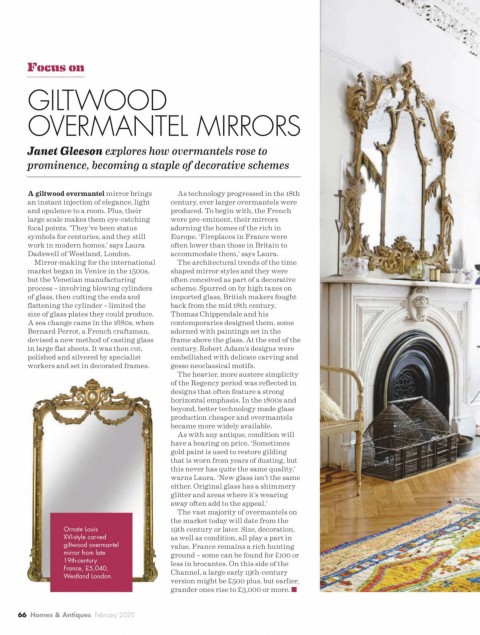
                       Ornate Louis                         19th century or later. Size, decoration,
                       XVI-style carved                     as well as condition, all play a part in
                       giltwood overmantel                  value. France remains a rich hunting
                       mirror from late                     ground – some can be found for £100 or
                       19th-century                         less in brocantes. On this side of the
                       France, £5,040,
                       Westland London.                     Channel, a large early 19th-century
                                                            version might be £500 plus, but earlier,
                                                            grander ones rise to £3,000 or more.


       66  Homes & Antiques  February 2020

