


Page 40 - Classic Rock - The Complete Story of Def Leppard 2019
P. 40
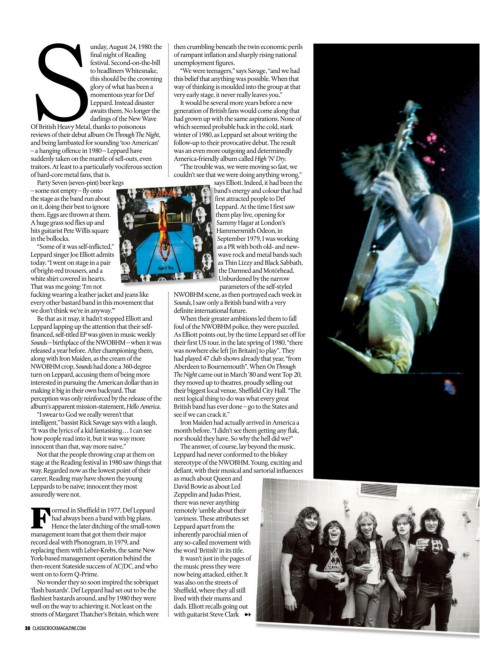
unday, August 24, 1980: the   then crumbling beneath the twin economic perils
                                 final night of Reading        of rampant inflation and sharply rising national
                                 festival. Second-on-the-bill   unemployment figures.
                                 to headliners Whitesnake,       “We were teenagers,” says Savage, “and we had
                                 this should be the crowning   this belief that anything was possible. When that
                                 glory of what has been a      way of thinking is moulded into the group at that
                                 momentous year for Def        very early stage, it never really leaves you.”
                                 Leppard. Instead disaster       It would be several more years before a new
                                 awaits them. No longer the    generation of British fans would come along that
            S darlings of the New Wave                         had grown up with the same aspirations. None of
            Of British Heavy Metal, thanks to poisonous        which seemed probable back in the cold, stark
            reviews of their debut album On Through The Night,   winter of 1980, as Leppard set about writing the
            and being lambasted for sounding ‘too American’    follow-up to their provocative debut. The result
            – a hanging offence in 1980 – Leppard have         was an even more outgoing and determinedly
            suddenly taken on the mantle of sell-outs, even    America-friendly album called High ’N’ Dry.
            traitors. At least to a particularly vociferous section   “The trouble was, we were moving so fast, we
            of hard-core metal fans, that is.                  couldn’t see that we were doing anything wrong,”
              Party Seven (seven-pint) beer kegs                              says Elliott. Indeed, it had been the
            – some not empty – fly onto                                       band’s energy and colour that had
            the stage as the band run about                                   first attracted people to Def
            on it, doing their best to ignore                                 Leppard. At the time I first saw
            them. Eggs are thrown at them.                                    them play live, opening for
            A huge grass sod flies up and                                     Sammy Hagar at London’s
            hits guitarist Pete Willis square                                 Hammersmith Odeon, in
            in the bollocks.                                                   September 1979, I was working
              “Some of it was self-inflicted,”                                 as a PR with both old- and new-
            Leppard singer Joe Elliott admits                                  wave rock and metal bands such
            today. “I went on stage in a pair                                  as Thin Lizzy and Black Sabbath,
            of bright-red trousers, and a                                      the Damned and Motörhead.
            white shirt covered in hearts.                                     Unburdened by the narrow
            That was me going: ‘I’m not                                        parameters of the self-styled
            fucking wearing a leather jacket and jeans like    NWOBHM scene, as then portrayed each week in
            every other bastard band in this movement that     Sounds, I saw only a British band with a very
            we don’t think we’re in anyway.’”                  definite international future.
              Be that as it may, it hadn’t stopped Elliott and   When their greater ambitions led them to fall
            Leppard lapping up the attention that their self-  foul of the NWOBHM police, they were puzzled.
            financed, self-titled EP was given in music weekly   As Elliott points out, by the time Leppard set off for
            Sounds – birthplace of the NWOBHM – when it was    their first US tour, in the late spring of 1980, “there
            released a year before. After championing them,    was nowhere else left [in Britain] to play”. They
            along with Iron Maiden, as the cream of the        had played 47 club shows already that year, “from
            NWOBHM crop, Sounds had done a 360-degree          Aberdeen to Bournemouth”. When On Through
            turn on Leppard, accusing them of being more       The Night came out in March ’80 and went Top 20,
            interested in pursuing the American dollar than in   they moved up to theatres, proudly selling out
            making it big in their own backyard. That          their biggest local venue, Sheffield City Hall. “The
            perception was only reinforced by the release of the   next logical thing to do was what every great
            album’s apparent mission-statement, Hello America.  British band has ever done – go to the States and
              “I swear to God we really weren’t that           see if we can crack it.”
            intelligent,” bassist Rick Savage says with a laugh.   Iron Maiden had actually arrived in America a
            “It was the lyrics of a kid fantasising… I can see   month before. “I didn’t see them getting any flak,
            how people read into it, but it was way more       nor should they have. So why the hell did we?”
            innocent than that, way more naive.”                 The answer, of course, lay beyond the music.
              Not that the people throwing crap at them on     Leppard had never conformed to the blokey
            stage at the Reading festival in 1980 saw things that   stereotype of the NWOBHM. Young, exciting and
            way. Regarded now as the lowest point of their     defiant, with their musical and sartorial influences
            career, Reading may have shown the young           as much about Queen and
            Leppards to be naive; innocent they most           David Bowie as about Led
            assuredly were not.                                Zeppelin and Judas Priest,
                                                               there was never anything
                   ormed in Sheffield in 1977, Def Leppard     remotely ’umble about their
                   had always been a band with big plans.      ’eaviness. These attributes set
            FHence the later ditching of the small-town        Leppard apart from the
            management team that got them their major          inherently parochial mien of
            record deal with Phonogram, in 1979, and           any so-called movement with
            replacing them with Leber-Krebs, the same New      the word ‘British’ in its title.
            York-based management operation behind the           It wasn’t just in the pages of
            then-recent Stateside success of AC/DC, and who    the music press they were
            went on to form Q-Prime.                           now being attacked, either. It
              No wonder they so soon inspired the sobriquet    was also on the streets of
            ‘flash bastards’. Def Leppard had set out to be the   Sheffield, where they all still
            flashiest bastards around, and by 1980 they were   lived with their mums and
            well on the way to achieving it. Not least on the   dads. Elliott recalls going out
            streets of Margaret Thatcher’s Britain, which were   with guitarist Steve Clark  É

          38  CLASSICROCKMAGAZINE.COM

