


Page 42 - Classic Rock - The Complete Story of Def Leppard 2019
P. 42
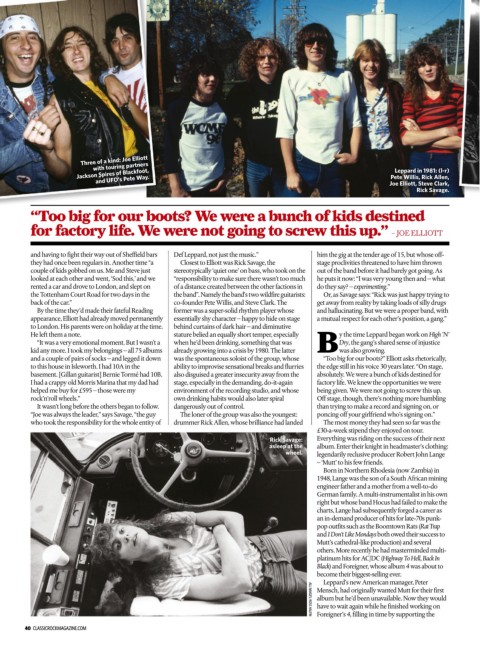
Three of a kind: Joe Elliott
                                  with touring partners
                            Jackson Spires of Blackfoot,                                                                                     Pete Willis, Rick Allen,
                                                                                                                                              Leppard in 1981: (l-r)
                                   and UFO’s Pete Way.
                                                                                                                                            Joe Elliott, Steve Clark,
                                                                                                                                                      Rick Savage.


            “Too big for our boots? We were a bunch of kids destined


            for factory life. We were not going to screw this up.” – JOE ELLIOTT


            and having to fight their way out of Sheffield bars   Def Leppard, not just the music.”               him the gig at the tender age of 15, but whose off-
            they had once been regulars in. Another time “a      Closest to Elliott was Rick Savage, the          stage proclivities threatened to have him thrown
            couple of kids gobbed on us. Me and Steve just     stereotypically ‘quiet one’ on bass, who took on the   out of the band before it had barely got going. As
            looked at each other and went, ‘Sod this,’ and we   “responsibility to make sure there wasn’t too much   he puts it now: “I was very young then and – what
            rented a car and drove to London, and slept on     of a distance created between the other factions in   do they say? – experimenting.”
            the Tottenham Court Road for two days in the       the band”. Namely the band’s two wildfire guitarists:   Or, as Savage says: “Rick was just happy trying to
            back of the car.”                                  co-founder Pete Willis, and Steve Clark. The       get away from reality by taking loads of silly drugs
              By the time they’d made their fateful Reading    former was a super-solid rhythm player whose       and hallucinating. But we were a proper band, with
            appearance, Elliott had already moved permanently   essentially shy character – happy to hide on stage   a mutual respect for each other’s position, a gang.”
            to London. His parents were on holiday at the time.   behind curtains of dark hair – and diminutive
            He left them a note.                               stature belied an equally short temper, especially         y the time Leppard began work on High ’N’
              “It was a very emotional moment. But I wasn’t a   when he’d been drinking, something that was               Dry, the gang’s shared sense of injustice
            kid any more. I took my belongings – all 75 albums   already growing into a crisis by 1980. The latter  Bwas also growing.
            and a couple of pairs of socks – and legged it down   was the spontaneous soloist of the group, whose    “Too big for our boots?” Elliott asks rhetorically,
            to this house in Isleworth. I had 10A in the       ability to improvise sensational breaks and flurries   the edge still in his voice 30 years later. “On stage,
            basement. [Gillan guitarist] Bernie Tormé had 10B.   also disguised a greater insecurity away from the   absolutely. We were a bunch of kids destined for
            I had a crappy old Morris Marina that my dad had   stage, especially in the demanding, do-it-again    factory life. We knew the opportunities we were
            helped me buy for £595 – those were my             environment of the recording studio, and whose     being given. We were not going to screw this up.
            rock’n’roll wheels.”                               own drinking habits would also later spiral        Off stage, though, there’s nothing more humbling
              It wasn’t long before the others began to follow.   dangerously out of control.                     than trying to make a record and signing on, or
            “Joe was always the leader,” says Savage, “the guy   The loner of the group was also the youngest:    poncing off your girlfriend who’s signing on.”
            who took the responsibility for the whole entity of   drummer Rick Allen, whose brilliance had landed    The most money they had seen so far was the
                                                                                                                  £30-a-week stipend they enjoyed on tour.
                                                                                                  Rick Savage:    Everything was riding on the success of their next
                                                                                                 asleep at the    album. Enter their knight in headmaster’s clothing:
                                                                                                       wheel.     legendarily reclusive producer Robert John Lange
                                                                                                                  – ‘Mutt’ to his few friends.
                                                                                                                     Born in Northern Rhodesia (now Zambia) in
                                                                                                                  1948, Lange was the son of a South African mining
                                                                                                                  engineer father and a mother from a well-to-do
                                                                                                                  German family. A multi-instrumentalist in his own
                                                                                                                  right but whose band Hocus had failed to make the
                                                                                                                  charts, Lange had subsequently forged a career as
                                                                                                                  an in-demand producer of hits for late-70s punk-
                                                                                                                  pop outfits such as the Boomtown Rats (Rat Trap
                                                                                                                  and I Don’t Like Mondays both owed their success to
                                                                                                                  Mutt’s cathedral-like production) and several
                                                                                                                  others. More recently he had masterminded multi-
                                                                                                                  platinum hits for AC/DC (Highway To Hell, Back In
                                                                                                                  Black) and Foreigner, whose album 4 was about to
                                                                                                                  become their biggest-selling ever.
                                                                                                                     Leppard’s new American manager, Peter
                                                                                                                  Mensch, had originally wanted Mutt for their first
                                                                                                                  album but he’d been unavailable. Now they would
                                                                                                                  have to wait again while he finished working on
                                                                                                                  Foreigner’s 4, filling in time by supporting the
                                                                                                                ALL IMAGES: ROSS HALFIN
          40  CLASSICROCKMAGAZINE.COM

