


Page 120 - Ultimate Visual Dictionary (DK)
P. 120
PLANTS

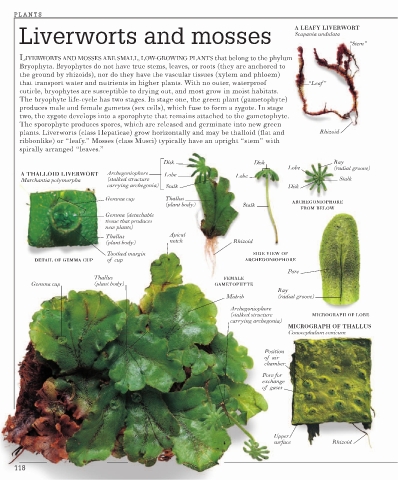
      Liverworts and mosses                                                        A LEAFY LIVERWORT
                                                                                   Scapania undulata
                                                                                                  “Stem”

      LIVERWORTS AND MOSSES ARE SMALL, LOW-GROWING PLANTS that belong to the phylum
      Bryophyta. Bryophytes do not have true stems, leaves, or roots (they are anchored to
      the ground by rhizoids), nor do they have the vascular tissues (xylem and phloem)
      that transport water and nutrients in higher plants. With no outer, waterproof   “Leaf”
      cuticle, bryophytes are susceptible to drying out, and most grow in moist habitats.
      The bryophyte life-cycle has two stages. In stage one, the green plant (gametophyte)
      produces male and female gametes (sex cells), which fuse to form a zygote. In stage
      two, the zygote develops into a sporophyte that remains attached to the gametophyte.
      The sporophyte produces spores, which are released and germinate into new green
      plants. Liverworts (class Hepaticae) grow horizontally and may be thalloid (flat and   Rhizoid
      ribbonlike) or “leafy.” Mosses (class Musci) typically have an upright “stem” with
      spirally arranged “leaves.”

                                              Disk                      Disk                  Ray
                                                                                 Lobe         (radial groove)
       A THALLOID LIVERWORT    Archegoniophore   Lobe             Lobe
       Marchantia polymorpha   (stalked structure                                              Stalk
                               carrying archegonia)  Stalk                       Disk
                              Gemma cup        Thallus
                                               (plant body)         Stalk         ARCHEGONIOPHORE
                                                                                     FROM BELOW
                              Gemma (detachable
                              tissue that produces
                              new plants)
                              Thallus           Apical
                              (plant body)      notch             Rhizoid
                               Toothed margin                          SIDE VIEW OF
           DETAIL OF GEMMA CUP  of  cup                              ARCHEGONIOPHORE
                                                                                 Pore
                           Thallus                             FEMALE
          Gemma cup        (plant body)                      GAMETOPHYTE
                                                                              Ray
                                                                Midrib        (radial groove)
                                                                 Archegoniophore
                                                                 (stalked structure     MICROGRAPH OF LOBE
                                                                 carrying archegonia)
                                                                                 MICROGRAPH OF THALLUS
                                                                                 Conocephalum conicum


                                                                          Position
                                                                          of  air
                                                                          chamber
                                                                          Pore for
                                                                          exchange
                                                                          of  gases


                                                                             Upper
                                                                             surface         Rhizoid


     118

