


Page 116 - Ultimate Visual Dictionary (DK)
P. 116
PLANTS

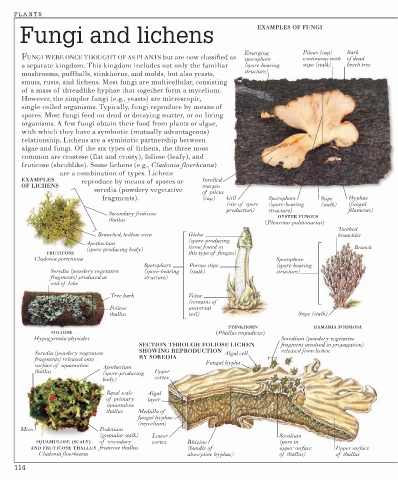
       Fungi and lichens                                                 EXAMPLES OF FUNGI


                                                                     Emerging        Pileus (cap)   Bark
       FUNGI WERE ONCE THOUGHT OF AS PLANTS but are now classified as   sporophore   continuous with  of dead
       a separate kingdom. This kingdom includes not only the familiar   (spore-bearing   stipe (stalk)  beech tree
                                                                     structure)
       mushrooms, puffballs, stinkhorns, and molds, but also yeasts,
       smuts, rusts, and lichens. Most fungi are multicellular, consisting
       of a mass of threadlike hyphae that together form a mycelium.
       However, the simpler fungi (e.g., yeasts) are microscopic,
       single-celled organisms. Typically, fungi reproduce by means of
       spores. Most fungi feed on dead or decaying matter, or on living
       organisms. A few fungi obtain their food from plants or algae,
       with which they have a symbiotic (mutually advantageous)
       relationship. Lichens are a symbiotic partnership between
       algae and fungi. Of the six types of lichens, the three most
       common are crustose (flat and crusty), foliose (leafy), and
       fruticose (shrublike). Some lichens (e.g., Cladonia floerkeana)
                  are a combination of types. Lichens
       EXAMPLES         reproduce by means of spores or   Inrolled
       OF LICHENS                                        margin
                           soredia (powdery vegetative
                                                         of  pileus
                             fragments).                 (cap)  Gill        Sporophore    Stipe   Hyphae
                                                                (site of  spore   (spore-bearing   (stalk)  (fungal
                                                                production)  structure)           filaments)
                               Secondary fruticose                            OYSTER FUNGUS
                               thallus
                                                                           (Pleurotus pulmonarius)
                                                                                               Toothed
                            Branched, hollow stem    Gleba                                     branchlet
                                                     (spore-producing
                         Apothecium
                         (spore-producing body)      tissue found in                               Branch
              FRUTICOSE                              this type of  fungus)
           Cladonia portentosa                                                Sporophore
                                         Sporophore   Porous stipe            (spore-bearing
               Soredia (powdery vegetative   (spore-bearing   (stalk)         structure)
               fragments) produced at    structure)
               end of  lobe
                                Tree bark            Volva
                                                     (remains of
                               Foliose               universal
                               thallus               veil)                          Stipe (stalk)
                                                                STINKHORN               RAMARIA FORMOSA
               FOLIOSE                                       (Phallus impudicus)
          Hypogymnia physodes                                                  Soredium (powdery vegetative
                                        SECTION THROUGH FOLIOSE LICHEN         fragment involved in propagation)
                                        SHOWING REPRODUCTION                   released from lichen
           Soredia (powdery vegetative                         Algal cell
           fragments) released onto     BY SOREDIA
           surface of  squamulose   Apothecium            Fungal hypha
           thallus            (spore-producing   Upper
                                            cortex
                              body)
                               Basal scale   Algal
                               of  primary   layer
                               squamulose
                               thallus  Medulla of
                                       fungal hyphae
                                       (mycelium)
       Moss                  Podetium
                             (granular stalk)   Lower                          Soralium
           SQUAMULOSE (SCALY)   of  secondary   cortex  Rhizine                (pore in
          AND FRUTICOSE THALLUS  fruticose thallus   (bundle of                upper surface   Upper surface
            Cladonia floerkeana                      absorptive hyphae)        of  thallus)   of  thallus

     114

