


Page 200 - Ultimate Visual Dictionary (DK)
P. 200
ANIMALS

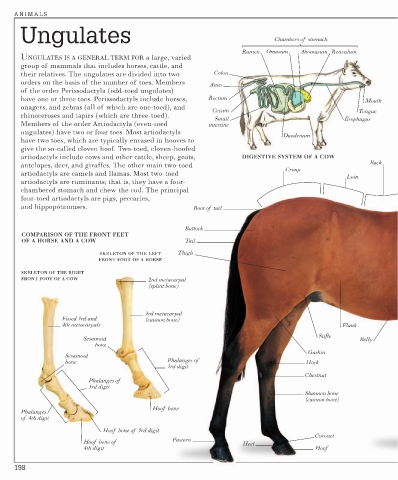
       Ungulates                                                             Chambers of  stomach


                                                                    Rumen  Omasum   Abomasum Reticulum
       UNGULATES IS A GENERAL TERM FOR a large, varied
       group of mammals that includes horses, cattle, and
       their relatives. The ungulates are divided into two   Colon
       orders on the basis of the number of toes. Members
                                                           Anus
       of the order Perissodactyla (odd-toed ungulates)
       have one or three toes. Perissodactyls include horses,   Rectum                                Mouth
       onagers, and zebras (all of which are one-toed), and
                                                            Cecum                                    Tongue
       rhinoceroses and tapirs (which are three-toed).
                                                             Small                               Esophagus
       Members of the order Artiodactyla (even-toed        intestine
       ungulates) have two or four toes. Most artiodactyls
                                                                                Duodenum
       have two toes, which are typically encased in hooves to
       give the so-called cloven hoof. Two-toed, cloven-hoofed
       artiodactyls include cows and other cattle, sheep, goats,    DIGESTIVE SYSTEM OF A COW
                                                                                                        Back
       antelopes, deer, and giraffes. The other main two-toed
                                                                                Croup
       artiodactyls are camels and llamas. Most two-toed
                                                                                                 Loin
       artiodactyls are ruminants; that is, they have a four-
       chambered stomach and chew the cud. The principal
       four-toed artiodactyls are pigs, peccaries,
       and hippopotamuses.                             Root of  tail

                                                    Buttock
       COMPARISON OF THE FRONT FEET
       OF A HORSE AND A COW                         Tail

                             SKELETON OF THE LEFT   Thigh
                            FRONT FOOT OF A HORSE
       SKELETON OF THE RIGHT
       FRONT FOOT OF A COW                2nd metacarpal
                                          (splint bone)


                                         3rd metacarpal
                  Fused 3rd and          (cannon bone)
                  4th metacarpals                                                               Flank
                                                                                          Stifle
                        Sesamoid                                                                     Belly
                           bone
                                                                                       Gaskin
                   Sesamoid
                   bone                        Phalanges of                           Hock
                                               3rd digit
                                                                                      Chestnut
                          Phalanges of
                          3rd digit
                                                                                      Shannon bone
                                                                                      (cannon bone)
                                           Hoof  bone
       Phalanges
       of  4th digit
                              Hoof  bone of  3rd digit
                                                                                        Coronet
                        Hoof  bone of            Pastern            Heel
                        4th digit                                                        Hoof


     198

