


Page 204 - Ultimate Visual Dictionary (DK)
P. 204
ANIMALS

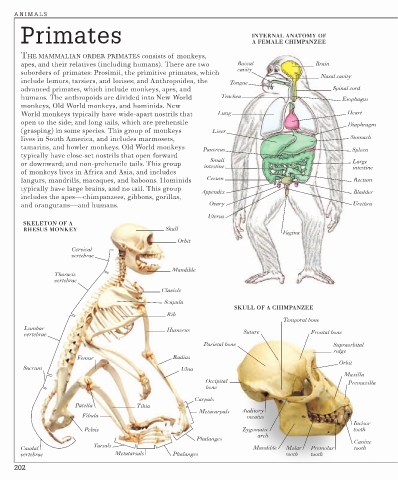
       Primates                                                        INTERNAL ANATOMY OF
                                                                       A FEMALE CHIMPANZEE
       THE MAMMALIAN ORDER PRIMATES consists of monkeys,
       apes, and their relatives (including humans). There are two   Buccal              Brain
                                                                   cavity
       suborders of primates: Prosimii, the primitive primates, which
                                                                                          Nasal cavity
       include lemurs, tarsiers, and lorises; and Anthropoidea, the   Tongue
       advanced primates, which include monkeys, apes, and                                   Spinal cord
       humans. The anthropoids are divided into New World     Trachea                           Esophagus
       monkeys, Old World monkeys, and hominids. New
       World monkeys typically have wide-apart nostrils that   Lung                              Heart
       open to the side; and long tails, which are prehensile                                     Diaphragm
       (grasping) in some species. This group of monkeys    Liver
       lives in South America, and includes marmosets,                                            Stomach
       tamarins, and howler monkeys. Old World monkeys
                                                         Pancreas                                  Spleen
       typically have close-set nostrils that open forward
                                                           Small                                   Large
       or downward; and non-prehensile tails. This group
                                                          intestine                                intestine
       of monkeys lives in Africa and Asia, and includes
       langurs, mandrills, macaques, and baboons. Hominids    Cecum                                Rectum
       typically have large brains, and no tail. This group
                                                         Appendix                                  Bladder
       includes the apes—chimpanzees, gibbons, gorillas,
       and orangutans—and humans.                          Ovary                                   Urethra
                                                           Uterus
       SKELETON OF A
       RHESUS MONKEY                           Skull
                                                                                Vagina
                                                  Orbit
                     Cervical
                     vertebrae
                                                 Mandible
                Thoracic
                vertebrae
                                              Clavicle
                                               Scapula
                                                                  SKULL OF A CHIMPANZEE
                                               Rib
                                                                                Temporal bone
        Lumbar                                 Humerus
        vertebrae                                                    Suture            Frontal bone
                                                          Parietal bone                       Supraorbital
                                                                                              ridge
                      Femur                      Radius
                                                                                               Orbit
        Sacrum                                     Ulna
                                                                                                 Maxilla
                                                          Occipital                               Premaxilla
                                                          bone
                                                       Carpals
                      Patella          Tibia
                                                        Metacarpals  Auditory
                        Fibula                                        meatus
                                                                                                   Incisor
                        Pelvis                                      Zygomatic                      tooth
                                                                         arch
                                                        Phalanges
                                                                                                   Canine
                           Tarsals
       Caudal                                                          Mandible  Molar   Premolar   tooth
       vertebrae                 Metatarsals     Phalanges                      tooth  tooth
     202

