


Page 214 - Ultimate Visual Dictionary (DK)
P. 214
THE HUMAN BODY
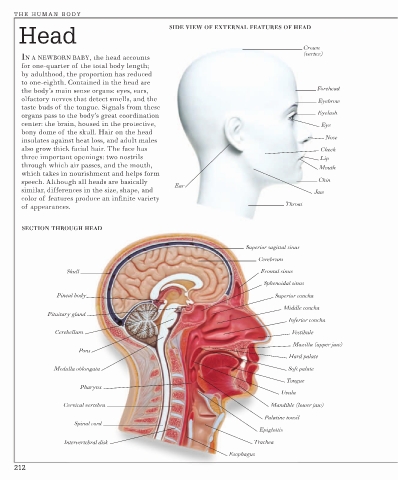
                                                SIDE VIEW OF EXTERNAL FEATURES OF HEAD
      Head

                                                                                     Crown
                                                                                     (vertex)
       IN A NEWBORN BABY, the head accounts
       for one-quarter of the total body length;
       by adulthood, the proportion has reduced
       to one-eighth. Contained in the head are
       the body’s main sense organs: eyes, ears,                                         Forehead
       olfactory nerves that detect smells, and the                                      Eyebrow
       taste buds of the tongue. Signals from these
                                                                                         Eyelash
       organs pass to the body’s great coordination
       center: the brain, housed in the protective,                                       Eye
       bony dome of the skull. Hair on the head
                                                                                           Nose
       insulates against heat loss, and adult males
       also grow thick facial hair. The face has                                          Cheek
       three important openings: two nostrils                                             Lip
       through which air passes, and the mouth,
                                                                                          Mouth
       which takes in nourishment and helps form
       speech. Although all heads are basically                                          Chin
                                                  Ear
       similar, differences in the size, shape, and                                     Jaw
       color of features produce an infinite variety
                                                                                Throat
       of appearances.

       SECTION THROUGH HEAD

                                                                     Superior sagittal sinus

                                                                         Cerebrum
                    Skull                                                Frontal sinus
                                                                          Sphenoidal sinus
                 Pineal body                                                 Superior concha
                                                                                Middle concha
              Pituitary gland
                                                                                 Inferior concha
                Cerebellum                                                        Vestibule
                                                                                  Maxilla (upper jaw)
                       Pons
                                                                                 Hard palate
                Medulla oblongata                                                Soft palate
                                                                                 Tongue
                       Pharynx
                                                                               Uvula
                   Cervical vertebra                                        Mandible (lower jaw)
                                                                          Palatine tonsil
                      Spinal cord
                                                                         Epiglottis
                   Intervertebral disk                                  Trachea
                                                                 Esophagus

     212

