


Page 228 - Ultimate Visual Dictionary (DK)
P. 228
THE HUMAN BODY

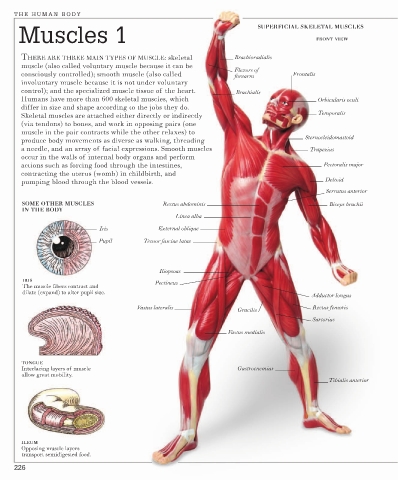
      Muscles 1                                                          SUPERFICIAL SKELETAL MUSCLES
                                                                                         FRONT VIEW


       THERE ARE THREE MAIN TYPES OF MUSCLE: skeletal             Brachioradialis
       muscle (also called voluntary muscle because it can be
                                                                  Flexors of
       consciously controlled); smooth muscle (also called        forearm         Frontalis
       involuntary muscle because it is not under voluntary
       control); and the specialized muscle tissue of the heart.   Brachialis
       Humans have more than 600 skeletal muscles, which                                 Orbicularis oculi
       differ in size and shape according to the jobs they do.
                                                                                         Temporalis
       Skeletal muscles are attached either directly or indirectly
       (via tendons) to bones, and work in opposing pairs (one
       muscle in the pair contracts while the other relaxes) to
                                                                                      Sternocleidomastoid
       produce body movements as diverse as walking, threading
       a needle, and an array of facial expressions. Smooth muscles                    Trapezius
       occur in the walls of internal body organs and perform
       actions such as forcing food through the intestines,                                Pectoralis major
       contracting the uterus (womb) in childbirth, and
       pumping blood through the blood vessels.                                            Deltoid
                                                                                            Serratus anterior
       SOME OTHER MUSCLES                     Rectus abdominis                              Biceps brachii
       IN THE BODY
                                                  Linea alba
                             Iris            External oblique
                            Pupil        Tensor fasciae latae


                                             Iliopsoas
       IRIS                                 Pectineus
       The muscle fibers contract and
       dilate (expand) to alter pupil size.
                                                                                       Adductor longus
                                       Vastus lateralis                                 Rectus femoris
                                                                   Gracilis
                                                                                        Sartorius
                                                                Vastus medialis


       TONGUE
       Interlacing layers of muscle                                Gastrocnemius
       allow great mobility.
                                                                                            Tibialis anterior


       ILEUM
       Opposing muscle layers
       transport semidigested food.

     226

